

Get Reliable Winners with Creative Ad Testing for Cultural Teams


Ad creative testing is the process of running controlled experiments that compare creative variants against a single hypothesis and one primary metric. Do it with audience isolation, predefined sample-size rules, and a documented winner propagation protocol. A valid early win looks like a 20% or larger gap in your primary metric, backed by at least 50 to 100 conversions on the leading variant—not a hunch based on three days of CTR.
TL;DR:
Proper ad testing requires a 20% or larger primary metric gap, with at least 50 to 100 conversions on the leading variant, to confirm early wins.
Testing should focus first on format and hook variables, as they account for nearly half of ad performance, rather than micro-optimizations.
Lock audience, budget, and settings before starting a test, and avoid making mid-test changes that invalidate results.
Use clearly defined sample size, duration, and statistical thresholds, such as 80-90% power and p less than 0.05, for reliable conclusions.
Log all hypotheses, results, and insights, including why variants fail, to build a pattern-based creative strategy that compounds over time.
Table of Contents
Building a Repeatable Ad Creative Testing Framework
Most marketing teams treat creative testing like a one-off event: launch two ads, glance at the results after a weekend, declare a winner, move on. That approach burns budget and teaches you almost nothing. A repeatable framework turns testing into a system that compounds, where each test seeds the hypothesis for the next one.
Here’s the sequence that holds up across accounts, budgets, and platforms.
Write the hypothesis before you write the ad. State it in one sentence: “Switching the hook from a discount offer to a curiosity-driven question will lower CPA by at least 15% because our audience skims past overt sales language.” Pick one primary metric, whether that’s CPA, ROAS, or conversion rate, and commit to it before you see a single data point.
Prioritize variables by impact, not convenience. Format and hook drive the largest swings in CTR and CPA, so test them first before touching smaller levers like copy length or button color. Offer comes next, then CTA phrasing, then thumbnail or cover image. Nielsen’s analysis of ad effectiveness attributes roughly 47% of performance to the creative itself, well ahead of targeting or reach. That’s the argument for spending your testing budget on creative variables before micro-optimizing audience segments.
Choose your test architecture deliberately. Sequential A/B testing works when traffic is limited: run variant A, then B, compare cleanly. Sequential testing with early kill rules adds a safety valve, letting you cut an underperformer after a minimum spend threshold rather than waiting the full duration. Parallel variation matrices, where several creative combinations run at once, suit teams with enough volume to split traffic without starving any single variant.
Set sample-size and duration rules before launch, not during. A common shortcut: don’t call a winner until the leading variant has 50 to 100 conversions and a CPA gap of 20% or more against its closest competitor. If you need more statistical rigor for a high-stakes decision, plan for 80 to 90% power and treat p < 0.05 as your significance bar for major budget shifts, per the statistical guidance most performance teams rely on.
Consolidate and propagate. Once a winner clears your threshold, pause the loser, scale the winning variant’s budget gradually (2 to 3 times over 72 hours, not overnight), and log the result. Then use the winning attribute, whether it’s a hook style or a format, as the seed for your next hypothesis.
Pro Tip: Keep a “graveyard” folder of killed variants with the reason they lost. Six months in, that folder tells you more about your audience’s preferences than any single winning ad ever will.
The biggest failure mode in this workflow isn’t bad creative. It’s skipping step one and improvising a hypothesis after you’ve already seen the numbers. That’s not testing. That’s storytelling with a spreadsheet.
Designing Tests That Actually Hold Up Statistically
A test can look clean and still produce a false answer if the audience overlaps, the metric is wrong, or you call it too early. Isolation is the first defense: make sure each variant reaches a distinct audience segment with minimal cross-contamination, and monitor for platform-level overlap, especially on Meta, where lookalike and broad targeting can quietly blend your test groups.
Choosing the right primary metric matters more than most teams admit. CPA and ROAS answer different business questions, and mixing them mid-test muddies your read. Attribution windows compound this problem: if one variant’s reporting window is 7 days and another’s defaults to 1 day, you’re comparing incompatible datasets even though the ad platform shows them side by side.
Sample size doesn’t require a statistics degree, but it does require discipline. Rules of thumb that hold up in practice:
Don’t call a test before the leading variant hits 50 to 100 conversions, the threshold that separates a real signal from noise.
Target statistical power of 80 to 90% for decisions with real budget consequences, and treat p < 0.05 as your bar for major calls, following the standard statistical framework for ad testing.
Avoid “peeking,” or checking results daily and stopping the moment a variant looks good. That inflates your false-positive rate more than most marketers realize.
Decide upfront whether you’re running a fixed-horizon test (set duration, check once) or a sequential test with predefined kill rules. Don’t switch methodologies mid-flight.
Practical threshold: A 20% gap in CPA, paired with at least 50 to 100 conversions on the top variant, is a workable operational shortcut when full 95% significance isn’t realistic on your budget or timeline, according to industry testing frameworks.
That threshold won’t satisfy a statistician, but it satisfies a media buyer who needs to make a Tuesday budget call. The trick is knowing which standard applies to which decision. A test that reallocates $500 a week can run on the loose threshold. A test that determines your creative direction for an entire quarter deserves the full 95% treatment.
Setting Up Tests in Meta Ads Manager and Google
Platform mechanics can quietly wreck an otherwise well-designed test. Each platform has its own guardrails, and ignoring them is the fastest way to produce results you can’t trust.
Meta Ads Manager offers a dedicated Experiments flow built for exactly this purpose. It isolates variants at the audience level and reports a confidence score once your test concludes. The critical rule: never change budgets or audience settings mid-test. Meta’s own guidance is explicit that doing so invalidates the comparison, because the algorithm reallocates delivery in ways that no longer match your original setup. Also respect the learning phase: an ad exiting learning behaves differently than one still in it, so comparing a settled variant against a fresh one skews your read.
Google’s Demand Gen and Experiment Center work differently. You can run asset-level A/B experiments across Discover, Gmail, and YouTube, with defined traffic splits and a recommended primary metric chosen before launch. Google’s system leans on conversion volume thresholds to determine when a result is trustworthy, so campaigns with thin conversion counts will sit in “inconclusive” territory longer than teams expect.
A quick do/don’t checklist for both platforms:
Do lock your budget and audience settings for the full test duration.
Do let Meta ads clear the learning phase before drawing conclusions.
Do confirm your Google experiment’s traffic split matches your intended sample allocation, not a default 50/50 you didn’t choose.
Don’t compare cross-platform results using different attribution windows.
Don’t launch a Google Demand Gen test with fewer conversions than your platform’s minimum guidance suggests. Underpowered tests report “no significant difference” even when a real one exists.
Reading Results Without Fooling Yourself
Statistical significance and business impact are not the same question, and confusing them is where a lot of “winning” creative tests quietly go wrong. A p-value tells you how likely your result is due to chance. Effect size and cost savings tell you whether the difference is big enough to act on. A variant that’s “significant” at a 2% CPA improvement might not be worth the operational disruption of switching creative, while a 25% improvement with a slightly looser confidence interval might be worth acting on immediately.
CTR is the metric most likely to mislead you. A high-CTR variant often pulls in curious clickers who never convert, inflating early enthusiasm while the actual business metric, whether that’s CPA or ROAS, tells a different story. Wait for conversion data whenever your budget allows it.
Once you’ve confirmed a real winner, follow a consolidation protocol instead of an abrupt switch:
Pause the losing variant, but don’t delete it. You’ll want the record later.
Increase the winner’s budget gradually, roughly 2 to 3 times over 72 hours rather than in one jump, to avoid disrupting delivery.
Monitor performance across that 72-hour window before fully promoting the winner into your main campaign structure.
Archive the full result, including the losing variant’s performance, in your testing log.
Extract the pattern (hook type, format, offer structure) and apply it as a starting hypothesis for your next test across other accounts or campaigns.
Pro Tip: Build a “cross-account patterns” document separate from your individual test log. When you notice the same hook style winning across three unrelated campaigns, that’s a playbook rule, not a coincidence.
Your approach to ROAS should inform which business impact threshold matters most for your consolidation decisions, since a small ROAS shift can represent a much larger dollar swing than an equivalent CPA shift, depending on your average order value.
Choosing Between A/B, Sequential, and Multivariate Testing
The right test format depends on your traffic volume and the question you’re actually trying to answer, not on which method sounds more sophisticated.
A/B testing fits limited traffic and situations where you need an isolated, unambiguous answer to one question: does hook A beat hook B? It’s the default for most small and mid-size advertisers, and sequential testing with disciplined kill rules often outperforms premature multivariate experiments unless you have sustained, concentrated volume to spare.
Multivariate testing earns its complexity only when you have concentrated volume and need to understand how variables interact, not just which one wins in isolation. Testing hook, format, and offer simultaneously reveals combinations you’d never discover through sequential A/B rounds. The tradeoff is steep: MVT guides generally recommend 30 to 60 day run times and traffic volumes well beyond what most single-account advertisers generate.
Use A/B or sequential testing when weekly conversions per variant are in the dozens, not the hundreds.
Reserve multivariate testing for accounts with consistent, high daily conversion volume across multiple creative slots.
Consider hybrid or automated variation-matrix approaches, which use algorithmic methods like best-arm identification across dominant creative dimensions to compress the number of combinations you need to test, rather than brute-forcing every permutation.
Automated variation matrices can shrink time-to-winner substantially compared to strictly sequential testing, sometimes down to 5 to 10 days at adequate spend versus weeks of sequential rounds. That speed comes at the cost of needing enough budget to fund several simultaneous variants without starving any of them.
Running Creative Testing as an Ongoing Operation
Testing only works as a system if someone owns the log, the cadence, and the follow-through. Without that structure, tests get launched, forgotten, and re-litigated from scratch six months later.
A minimal testing log needs these fields: test name, hypothesis, primary metric, start and end date, conversions per variant, result, and the action taken. That’s it. Overbuilt logs with twenty columns rarely get filled in consistently, and an unfilled log is worse than no log at all.
A cadence that scales well across teams:
Launch new hypotheses weekly, tied to whatever creative variable sits highest on your priority list.
Hold bi-weekly readouts where the team reviews active tests and makes kill/scale decisions.
Run a monthly meta-analysis across all closed tests, looking for patterns that repeat across accounts.
Roles matter more than most teams plan for:
Someone owns hypothesis design and keeps it disciplined, one variable, one metric.
Someone owns production, turning hypotheses into actual creative assets on schedule.
Someone owns analysis, reading results against the pre-set thresholds rather than post-hoc rationalizing.
Someone owns propagation, making sure winners actually get scaled and logged, not just noted in a Slack thread.
Budget discipline closes the loop: run your portfolio of tests so no single test gets starved of spend because three others launched the same week. A rough rule is to cap active tests at a number your weekly budget can fund to statistical relevance within 10 to 14 days.
How Opti Arts Adapts This Framework for Cultural Organizations
Ticketed events don’t behave like ecommerce funnels. A theater’s spring season trailer has a hard curtain-up date, a fixed number of seats, and a much smaller audience pool than a retail campaign chasing a national market. Opti Arts builds hypothesis design around that reality: instead of testing indefinitely, we compress the testing window to match the sales curve, front-loading hook and format tests in the weeks before single-night engagements go on sale.
Cultural campaigns rarely get the luxury of massive traffic volume, so the testing log matters even more. Every test needs a documented hypothesis and a hard stop date, because a subscription renewal campaign or a single-night engagement won’t wait for a slow-burning multivariate matrix to resolve.
Some clients have reported improved return on ad spend and stronger attendance, results that come from disciplined creative iteration rather than one lucky ad. The same testing log fields, hypothesis, metric, sample size, result, that work for a retail account apply directly to a museum’s membership campaign or a symphony’s subscription push. We’ve applied similar experimental thinking to newer channels, including testing generative AI-driven ad concepts for performing arts clients looking for fresh creative angles.
The caveat for smaller-volume cultural campaigns: strict 95% significance is often out of reach given limited conversion counts.
Real Test Scenarios Worth Studying
A museum testing membership ads found that thumbnail choice, specifically, a close-up of a single striking exhibit piece versus a wide shot of the gallery, drove a meaningful CTR gap. But the wide-shot variant converted better once the team waited for actual membership sign-ups instead of judging on CTR alone. That’s the CTR trap in action: the flashier thumbnail won attention, but the calmer one won customers.

A concert venue running Google Demand Gen tests split traffic between a video-first asset and a static image carousel promoting a single-night engagement. The video asset needed more spend to clear Google’s conversion threshold for a confident read, but once it did, it beat the carousel on cost per ticket by a wide enough margin to justify shifting the entire campaign’s creative mix.
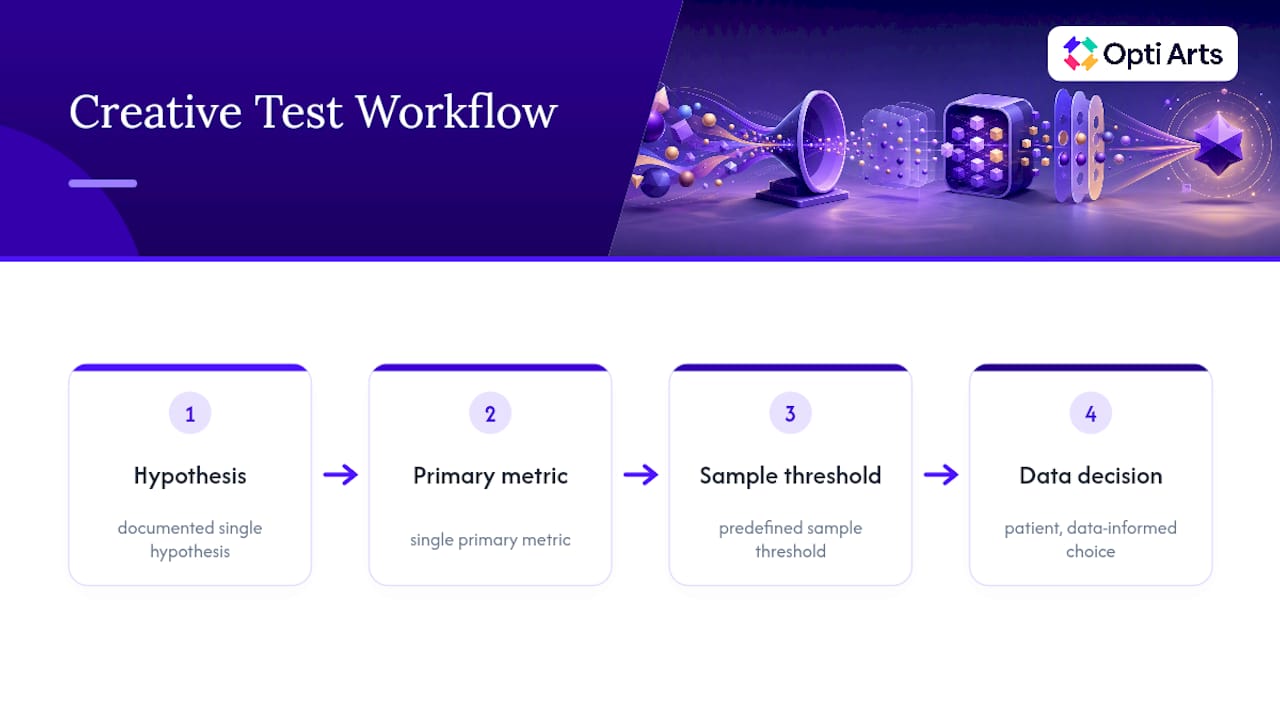
Each of these scenarios shares a structure: one hypothesis, one primary metric, a defined sample threshold, and a willingness to let the data override institutional assumptions about what “should” work. None of them required exotic tooling, just discipline in setup and patience in reading results.
Turning Test Results Into Your Next Creative
A test that ends without a follow-up creative is a wasted test. The point of finding a winner isn’t just to run it longer, it’s to understand why it won and build that insight into the next round.
Start by isolating which specific attribute drove the win. If a curiosity-driven hook beat a discount hook, don’t assume the entire creative direction should shift. Test whether that curiosity approach holds up against a different offer structure, or whether it was specific to that particular headline. Iteration means testing the reason behind the win, not just repeating the winning ad indefinitely.
Build your next hypothesis directly from the pattern. If format (video versus static) proved to be the dominant variable in one test, your next round should hold format constant and test a secondary variable, like CTA phrasing, within that winning format. This is how testing compounds instead of restarting from zero every cycle.
Watch for creative fatigue on your winners too. A variant that crushed its test in week one can decay by week six as your audience sees it repeatedly. Set a review checkpoint, roughly every three to four weeks for high-spend campaigns, to check whether frequency has crept up and performance has started sliding. When it has, that’s your signal to refresh the losing elements while keeping the proven structural attribute intact.
Connecting Creative Wins to Campaign-Wide Strategy
A winning ad creative doesn’t operate in isolation. It interacts with targeting, budget allocation, and funnel stage, and treating it as a standalone win misses the bigger opportunity.
Once a creative test produces a clear winner, check whether the insight applies beyond the original campaign. A hook that worked for a subscription renewal push often carries lessons for acquisition campaigns targeting cold audiences, even if the specific offer changes. Cross-pollinating creative insights across campaign types, top-of-funnel awareness versus bottom-of-funnel conversion pushes, prevents teams from re-learning the same lesson in every new campaign.
Budget allocation should follow creative performance, not the other way around. If a winning variant is outperforming on ROAS, that’s a signal to reconsider how much of your total spend sits in that ad set versus others, not just to scale the ad set in isolation. Programmatic and cross-channel campaigns benefit from this feedback loop especially, since scaling decisions across multiple channels depend on knowing which creative approach is actually driving the numbers versus which channel happens to be reporting them.
Treat your testing program as an input to media planning, not a separate workstream. When your quarterly planning process starts with “what did our tests teach us” rather than “what’s our budget this quarter,” creative optimization stops being reactive and starts shaping strategy.
Common Pitfalls That Quietly Invalidate Your Tests
The most common mistake isn’t a bad hypothesis. It’s changing something mid-test, a budget tweak, an audience adjustment, a bid strategy switch, and then treating the results as if the test ran cleanly from start to finish. Platforms like Meta explicitly warn against this because it resets delivery patterns in ways that corrupt the comparison.
Confirmation bias shows up constantly in creative testing. A marketer with a strong hunch about which variant will win often stops the test the moment early data leans that direction, ignoring the sample-size threshold they set beforehand. That’s peeking, and it inflates false positives more than most people expect.
Testing too many variables at once without the traffic to support it is another frequent trap. A test comparing four different hooks, three formats, and two offers simultaneously, on a budget that barely supports a clean two-way A/B, produces noise dressed up as insight.
Watch for these specific failure patterns:
Declaring a winner based on CTR alone, before conversion data has had time to settle.
Running a test through a major external event (a holiday, a news cycle) that distorts baseline behavior for both variants unevenly.
Ignoring audience overlap between test groups, especially on platforms with broad or lookalike targeting.
Comparing results across mismatched attribution windows, treating a 7-day click window and a 1-day click window as equivalent.
Killing a test too early because the sample size hasn’t reached your predefined threshold, then treating the early read as final.
Every one of these is preventable with the same fix: write the rules down before you launch, and don’t deviate once the test is live.
What Actually Separates Winning Testing Programs From the Rest
Most teams treat creative testing as a checkbox: run a test, get an answer, move on. That’s backwards. The programs that actually compound results treat the test log itself as the asset, not any single winning ad. A hook that wins this quarter will fatigue eventually. The pattern behind why it won, format preference, tone, offer structure, is what survives and transfers to your next campaign.
The mistake I see most often isn’t statistical. It’s operational: teams skip the hypothesis step entirely and back into one after seeing which variant already won. That’s not testing, that’s narrative construction after the fact, and it teaches you nothing you can reuse.
If I had to pick the single highest-leverage habit, it’s this: test format and hook before anything else, and never let a test run without a documented hypothesis written down before launch. Everything downstream, sample size, significance, propagation, only works if that first step is honest.
Here’s a nonobvious tip most guides skip: your “losing” variants are as valuable as your winners if you log why they lost. That losing pile becomes a map of audience preferences no single winning ad can give you.
Pick one ad set. Write one hypothesis. Run it this week with a documented log. That’s the entire barrier to entry.
— Trevor
How Opti Arts Turns This Framework Into Daily Practice
Running a disciplined testing program takes time most cultural marketing teams don’t have, especially with a season to program and a box office to manage simultaneously. This gap can be addressed by building and running the hypothesis, sample-size, and propagation cycle described here directly into paid media management, so teams get the results without owning the operational overhead.
Our solutions for cultural organizations cover hypothesis design, test execution across Meta, Google, and streaming platforms, and the analysis work that turns a winning variant into a scaled campaign. For organizations that want visibility into how tests translate into ticket sales, a Breakeven dashboard can connect campaign performance directly to box office data in real time, avoiding waits on monthly reports to know whether a creative test actually moved tickets.
If your team is running tests without a documented log, or scaling winners without a consolidation protocol, that’s usually the fastest fix available. Consider requesting a demo to see how testing cadence and reporting can be structured around a season calendar, not a generic ecommerce framework.
Sources
Recommended