

Blended $26 CPM: CTV Ad Costs and Budgets for Marketers & SMBs

Updated: 4 days ago

Blended U.S. connected TV CPMs land around $26 in 2026, with most working campaigns falling between $25 and $35 and the broader market stretching from $15 to $45 depending on inventory and targeting. As a quick rule of thumb: divide your budget by the CPM, multiply by 1,000, and you have your impression count. A $500 test at $25 CPM buys roughly 20,000 impressions.
TL;DR:
Most CTV campaigns operate within a $25 to $35 CPM range, with prices rising to $45 or more for premium inventory or addressable targeting.
Higher CPMs are driven by factors such as content type, targeting precision, buying method, seasonality, and additional platform fees.
Entry-level budgets for testing or small campaigns typically start around $500, with larger multi-channel efforts costing $3,000 to $6,000 or more monthly.
Combining multiple inventory tiers, especially FAST channels for volume and premium for impact, generally yields a blended CPM close to $26.
Proper measurement involves tracking impressions, completed views, and incrementality, with fee transparency crucial to assessing true costs.
Table of Contents
What Is the Real CTV Advertising Cost Right Now?
Forget the scary agency quotes you might have seen a few years back. The blended average CPM sits near $26, with a comfortable working range of $25 to $35 for most standard programmatic buys. The full market spans $15 to $45 once you account for every inventory type from bargain-bin FAST channels to premium live sports.
Here’s how the tiers actually break down:
FAST/AVOD (free ad-supported streaming): roughly $15 to $25 CPM
Standard programmatic: roughly $25 to $45 CPM
Premium/live-sports inventory: roughly $45 to $65 CPM
Addressable, first-party-targeted buys: roughly $45 to $85 CPM
Pro Tip: Compare these numbers against your last cable buy before you flinch at a CTV quote. Linear TV spots often run higher on a cost-per-thousand basis once you factor in production and the fact that a chunk of that audience is watching on delay or muting through the break.
CTV also tends to undercut premium social video CPMs for comparable completed-view guarantees, largely because inventory supply has grown faster than demand, pushing prices down 10 to 30% in recent buying cycles even as total CTV spend keeps climbing.
What Drives CTV CPM Pricing Up or Down?
Six key factors influence your CPM pricing.
Targeting granularity: Layering first-party data or household-level segments tends to raise CPM but reduce wasted impressions.
Content environment: Live sports and premium premieres usually come at a higher cost; syndicated reruns on free channels generally cost less.
Buying route: Self-serve platforms often come with lower CPMs but less precision; programmatic DSPs or premium direct deals command higher CPMs for more precise buying.
Ad length and completed-view pricing: Many CTV platforms charge based on completed views, which affects the effective CPM.
Seasonality and market size: Prices tend to rise in Q4 and in major metropolitan areas.
Overhead: Additional platform fees, data costs, and third-party verification are added on top of the base media rates.
Pro Tip: Ask every vendor for the media CPM and the fee stack separately. A $28 CPM with a 20% platform fee and a data surcharge isn’t a $28 CPM anymore.
How Do You Buy CTV Ads and What Do Entry Budgets Look Like?
You have three real paths in, and each one comes with its own floor.
Self-serve platforms. Entry points can start around $500, making this the natural home for a first test. Targeting is broader and CPMs typically sit toward the lower end of the range, but you trade away some precision.
Programmatic/DSP buying. Expect monthly commitments starting near $2,000 in exchange for household-level targeting and cross-platform reach across Hulu, Roku, and other apps from one seat.
Direct-sold/premium inventory. Higher commitments, higher CPMs, but you’re buying guaranteed placement next to live sports or flagship content, not an algorithm’s best guess.
Sample budget buckets: a first streaming test runs $500 to $1,000; local awareness campaigns typically land at $2,000 to $3,000; multi-channel lead-generation programs often need $3,000 to $6,000 or more per month to show measurable movement.
Which Inventory Tier Should Get Your Dollars?
Think of CTV inventory like ticket pricing tiers at your own venue: cheap seats fill the house, premium seats create the buzz.
FAST/AVOD: Low CPM, broad reach. Good for building frequency without burning budget.
Standard programmatic: The workhorse tier. Balanced cost against real targeting control.
Premium/live events: High CPM, but the attention level (and completion rate) justifies the spend for a curtain-up moment or a season announcement.
Addressable/first-party: The most expensive tier, and the most precise. Best reserved for retargeting past ticket buyers or lookalike households.
Most efficient advertisers blend tiers rather than picking one. Running FAST channels for volume alongside a smaller premium slice for impact tends to land your effective CPM somewhere in the middle of the market range, closer to that $26 blended figure than either extreme.
How Do You Turn a CTV Budget Into Impressions?
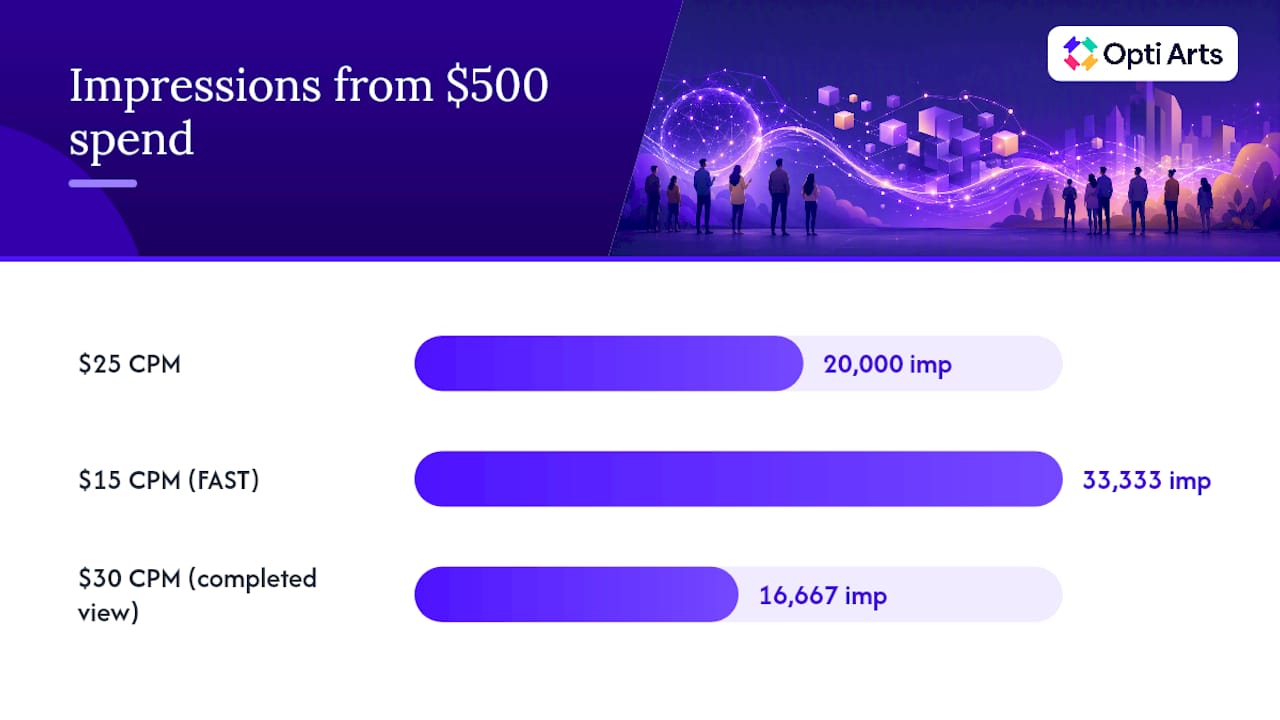
The math is simple once you have it in front of you: impressions = (budget ÷ CPM) × 1,000. At a $25 CPM, a $500 budget buys about 20,000 impressions; drop to a $15 CPM on a FAST channel and that same $500 stretches to roughly 33,333 impressions.
Completed-view pricing complicates the comparison in your favor, though. Since most CTV inventory charges only for non-skippable completed views, a $30 CPM there often delivers more actual eyeballs-on-ad than a skippable pre-roll CPM elsewhere.
Scenario | Typical Budget | What It Tests |
First-time test | around $500 to $1,000 | Whether CTV moves your metrics at all |
Local awareness push | around $2,000 to $3,000 | Frequency and recall in one metro market |
Multi-channel lead-gen | several thousand dollars to about $6,000 or more | Attribution across CTV plus other channels |
Budgets below approximately $500 rarely generate enough impression volume to reliably measure results.
How Can You Lower Your Effective CTV Cost?
Cutting your loaded CPM comes down to sequencing and discipline, not just haggling over rates.
Start broad, then narrow. Let the algorithm collect a couple weeks of data before you layer on tight segments.
Cap frequency. Nobody buys a ticket because they saw your spot nine times in one evening.
Design for the big screen. Bigger type, a clear call to action in the first three seconds, and no reliance on tiny logos.
Track it properly. Pixels, UTM parameters, and an incrementality test tell you what a last-click report never will. Our piece on decoding ROI in programmatic advertising walks through the mechanics.
Blend FAST with premium. Run volume cheap, spend precision dollars where they count.
Calculate your loaded CPM. Add platform fees, data costs, and verification before you compare vendors, or you’re comparing apples to a much cheaper orange.
Pro Tip: If a vendor quote doesn’t break out the fee stack from the media rate, ask again before you sign. That gap is usually where the “surprise” cost hides. Our guide to getting higher return on ad spend covers the follow-up moves once your budget is live.
What CTV Costs Actually Look Like for a Theater or Museum
We treat CTV the same way we’d treat a new venue booking: test small, measure hard, then scale what works. That usually means a modest first flight tied directly to a season announcement or single-night engagement, tracked against actual box office movement, not just view counts. Testing cadence can be paired with real attendance data to make CPM a more tangible metric connected to ticket sales.
— Trevor
How Opti Arts Plans, Buys, and Measures Your CTV Campaigns
Running the budgeting math above is one thing. Executing it across Hulu, Roku, and a dozen other apps while your team is also selling tickets and managing a season is another. There are alternatives to traditional agency retainers for cultural organizations weighing CTV for the first time, offering bespoke media planning, creative built specifically for the big screen, and programmatic buying handled by specialists familiar with different types of cultural events.

Campaigns can report back through a dashboard that ties ad spend directly to ticket sales and attendance lift instead of leaving advertisers guessing whether a CPM turned into a seat filled. If you’re ready to see what a realistic CTV budget looks like for your organization, explore our solutions and set up a conversation about your next season.
Where These Benchmarks Come From
The CPM ranges and budget figures throughout this guide draw from a handful of primary sources worth bookmarking if you want to check quotes yourself:
Adwave’s Q2 2026 CTV CPM pricing data
NA Media Experts’ 2026 CTV CPM benchmarks by industry
Mobilerad’s breakdown of what small businesses actually pay for Hulu advertising
Paramount Ads Manager’s guide to optimizing CTV CPMs
Sources
Recommended