

8–12 Weeks to Launch: Seasonal Campaign Planning for Marketers

Updated: 3 days ago

Pick one seasonal window that matches how your audience actually buys, then lock a single creative idea before you touch a channel plan. Everything downstream, timelines, asset production, channel mix, measurement, depends on getting that first call right. Map your historical demand or one clear intent signal, set one measurable goal against it, and use the playbook below for lead times, asset matrices, channel tactics, testing, and the debrief that makes next season easier.
TL;DR:
Focus on a single seasonal window aligned with your audience’s demand signals, rather than chasing every holiday or event on the calendar.
Validate your chosen window with three checks: repeatable sales or attendance data, search spikes, and audience engagement signals.
Build a clear, one-sentence creative idea that addresses audience tension and resolves it, then adapt it consistently across all channels.
Start planning major campaigns at least 8 to 12 weeks in advance, including creative development, testing, and approvals, to avoid rushed production costs.
Continuously monitor competitor activity during the season to adjust timing, messaging, or offers and prevent being outbid or overshadowed during key windows.
Table of Contents
How Do You Choose the Right Seasonal Window for Seasonal Campaign Planning?
How Far in Advance Should You Start Planning a Seasonal Campaign?
How Do You Build One Creative Idea That Works Across Every Channel?
Which Channels Matter Most, and When Should Each One Activate?
How Are AI and Streaming Changing Seasonal Campaign Planning in 2026?
How Should You Allocate Budget and Resources for a Seasonal Campaign?
How Do Seasonal Campaigns Fit Into Your Overall Marketing Strategy?
Opti Arts Perspective: Applying This Playbook to Cultural Organizations
How Do You Choose the Right Seasonal Window for Seasonal Campaign Planning?
The retail calendar tells you when everyone else is spending. Your own data tells you when your specific buyers are ready to act, and those two calendars overlap less often than most marketing teams assume. A theater selling holiday tickets in October is chasing a different behavior than a retailer selling gifts in November, even though both sit on the same page of a marketing calendar.
Start by separating buyer-specific demand from generic retail hype. If a museum’s members buy renewal packages every January regardless of weather or promotions, that’s a demand signal worth building around, whether or not it aligns with a national “shopping holiday.”
A tiering system keeps you from spreading your budget across every date on the calendar. AdRoll’s guidance on seasonal marketing recommends picking moments intentionally rather than chasing every minor holiday, since diluted messaging across too many small windows tends to underperform a concentrated push on the moments that matter.
Three checks validate whether a window deserves real investment:
Historical sales or attendance data. Pull the last two to three cycles for that period and look for a repeatable lift, not a one-time spike.
Search and traffic spikes. A sustained rise in branded or category search volume in the weeks leading into the window signals genuine intent, not just calendar awareness.
Audience intent signals. Email opens, gift-guide clicks, or ticket-page visits that cluster in a specific window tell you when your actual audience starts paying attention, which often runs earlier than the promotional date itself.
Category-level spending data, like Statista’s tracking of Mother’s Day expenditure, can help validate whether a niche seasonal moment carries enough dollar volume to justify a dedicated push versus folding it into an evergreen campaign.
What KPIs Should You Set for a Seasonal Campaign?
Match your KPI to the job the campaign is actually doing, not to a generic revenue target. A three-tier ladder keeps that distinction honest: awareness metrics tell you whether the right people noticed, conversion metrics tell you whether they acted, and retention metrics tell you whether the campaign built anything that outlasts the season.
Revenue-focused seasonal pushes, holiday sales, flash promotions, single-night ticket drops, live or die on conversion metrics: cost per acquisition, return on ad spend, and sell-through rate against inventory or capacity. Long-term value goals, membership growth, subscriber lists, season-ticket renewals, need retention metrics layered on top, because a campaign that hits its CPA target but attracts only one-time discount shoppers hasn’t actually built anything durable.
Quick statistic to plan around: Digiday’s 2026 research found that CTV usage for holiday campaigns rose to 45% of surveyed marketers, up from 23% the previous year, which shifts where awareness-tier budget needs to go before you can even measure conversion.
Common goal-KPI pairs worth borrowing:
Sales lift goal: track CPA, ROAS, and average order value against a pre-season baseline.
Email list growth goal: track new signups, list-to-purchase conversion within 60 days, and unsubscribe rate.
Event or ticket attendance goal: track cost per ticket, sell-through rate by showtime or gallery slot, and repeat-attendance rate the following season.
Don’t run one blended ROAS target across the whole campaign window. Forecasting by funnel stage protects your algorithmic learning phase from getting whipsawed by a slow opening week that later turns into a strong closing one.
How Far in Advance Should You Start Planning a Seasonal Campaign?
Major seasonal windows need 8 to 12 weeks of runway. That covers creative development, a testing round, and a buffer for the inevitable client or leadership revision cycle. Micro-moments, a single-night event promotion or a flash sale tied to a local happening, can compress to 2 to 4 weeks, but only if your asset kit already exists and you’re adapting rather than building from scratch.
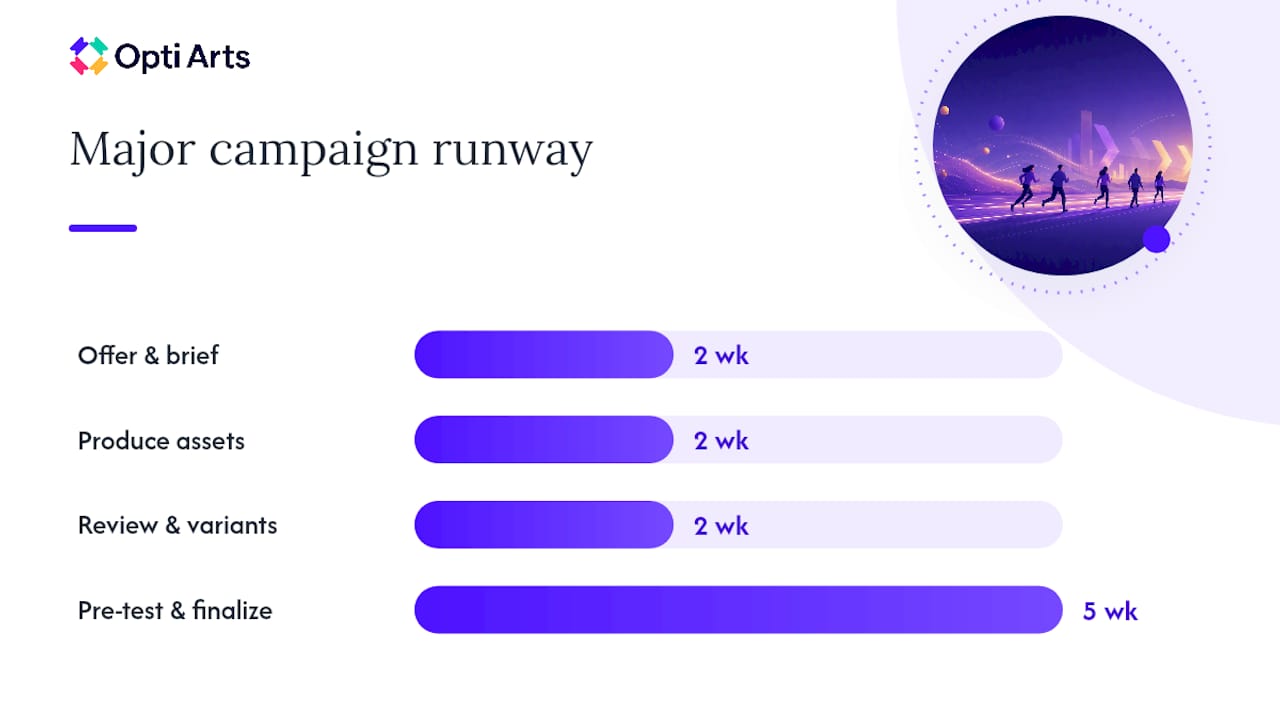
Versely’s production-system approach to seasonal planning treats the lead time itself as a budget line. Waiting until three weeks out to start a major campaign usually means paying premium rates for rushed production and buying media inventory after prices have already climbed with demand.
A practical runway for a major window looks like this:
Weeks 12 to 10: finalize the offer, the single creative idea, and the channel mix; brief creative and media teams.
Weeks 10 to 8: produce hero assets (video, photography, key copy) and build the full asset matrix.
Weeks 8 to 6: run internal review and legal or brand approval; begin cutting channel-specific variants.
Weeks 6 to 4: launch a limited pre-test across paid social and email to validate messaging before full spend commits.
Weeks 4 to 1: finalize scheduling, load creative into ad platforms, and confirm tracking pixels and UTMs fire correctly.
Launch week: go live with a staggered rollout across channels rather than a single simultaneous push.
The asset matrix itself is a grid of placements against creative angles: each channel (email, paid social, CTV, display) crossed against each message variant (urgency, value, storytelling, social proof). A mandatory baseline set includes one hero video cutdown at three lengths, five to seven static or carousel images, three email templates, and short-form vertical video for social and CTV bumpers.
Before anything launches, run a QA checklist:
Confirm tracking parameters and pixel firing across every landing page.
Check that offer terms match across email, paid ads, and the landing page itself.
Verify creative renders correctly on mobile, CTV, and desktop.
Confirm budget caps and pacing settings match the flight dates, not the calendar month.
How Do You Build One Creative Idea That Works Across Every Channel?
Write the idea as a single sentence before you write a single piece of copy: [target audience] feels [tension], and [your offer] resolves it by [specific mechanism]. A theater might write it as: “Longtime subscribers feel like they’ve seen it all, and this season’s lineup resolves that by opening with a piece none of them expect.”
That one sentence becomes the filter for every channel-specific execution. An email subject line built from it might read “Not the season you’re expecting.” A hero video hook opens on the same tension in the first three seconds, since a slow build loses attention before the resolution ever lands. SMS copy strips it down further: “The lineup nobody predicted. Tickets open Friday.”
Channel translation checklist:
Email: lead with the tension in the subject line, resolve it in the preview text, and confirm it in the first line of body copy.
Video hooks: state the tension visually or verbally within the first three seconds, before any logo or branding appears.
SMS: cut straight to the resolution and the action; there’s no room for setup in 160 characters.
Paid social: test the tension-first version against a resolution-first version to see which stops the scroll for your specific audience.
Urgency and offer framing deserve real care here. Digiday’s 2026 reporting found that brands are leaning toward personalized offers and loyalty incentives over blanket deeper discounts during periods of economic uncertainty, protecting long-term brand value instead of training buyers to wait for the next markdown.
Pro Tip: Write three versions of your one-sentence idea, then have someone outside the campaign team pick which one they’d actually stop scrolling for. The version that survives that filter usually beats the one your team liked best internally.
Which Channels Matter Most, and When Should Each One Activate?
Each channel plays a different role in a seasonal campaign, and activating them in the wrong order wastes the lead time you just spent weeks building.
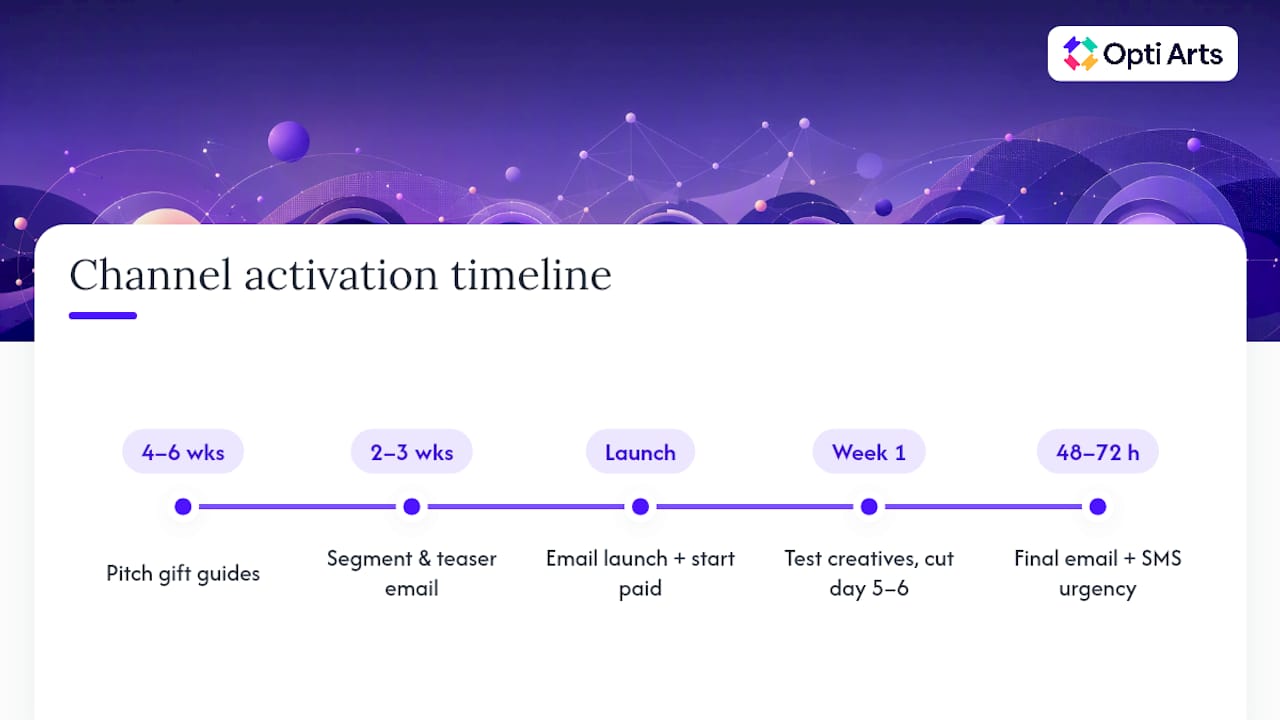
Email carries the narrative arc of the campaign. Segment your list before you write a single email, since a renewing member and a first-time browser need different opening lines even if they’re reading the same offer. A typical sequence runs an early teaser two to three weeks out, a launch announcement on go-live day, a mid-window reminder, and a final urgency send in the closing 48 hours.
SMS exists for urgency, not storytelling. Mailchimp’s channel-mix guidance treats SMS as the closer: send it in the final 24 to 72 hours of a window, when open rates for text messages consistently outperform email precisely because the format signals immediacy.
Paid social and search need a testing cadence, not a set-and-forget budget. Launch three to five creative variants in week one of the flight, cut underperformers by day five or six based on early click-through and conversion signals, and reallocate spend toward whichever angle is actually working. Marketplace and gift-guide placements run on their own clock. Editorial teams typically lock gift guides four to six weeks before a major holiday, so pitching or buying into them needs to happen well before your main campaign launches.
CTV and streaming deserve a bigger seat at the table in 2026 than most seasonal plans have historically given them. Digiday’s research found CTV usage among surveyed marketers for holiday planning rose to 45%, up from 23% a year earlier, while linear TV usage rose to 33% from 13%. That’s a real budget shift, not a trend piece. Plan CTV creative with the same lead time as your hero video asset, since streaming platforms often require longer-form cuts than social feeds, and measure it through view-through conversions rather than expecting last-click attribution to tell the whole story. Opti Arts’ guide to connected TV and OTT advertising covers the measurement setup in more depth.
What Happens During Launch Week?
Launch week runs on a routine, not a scramble. Queue every scheduled asset before Monday morning and keep one reactive slot open per day for whatever the first 24 hours of data tells you to adjust.
Queue and schedule everything the weekend before. Confirm every email, social post, and ad set is loaded and scheduled, not sitting in draft, before the first day of the flight.
Run a daily optimization huddle. Review yesterday’s numbers each morning and make one of three calls per channel: scale spend on what’s converting, pause what’s clearly underperforming after a meaningful sample, or reallocate budget toward the strongest early signal.
Reserve one reactive asset slot daily. Hold back one piece of flexible creative, a quick social post or an SMS send, that can respond to something unexpected: a sellout, a weather event, a competitor move.
Assign clear ownership before launch, not during it. One person owns creative swaps, one owns budget pacing, one owns tracking and QA. Without that split, small issues sit unresolved because everyone assumes someone else is watching.
A campaign that runs this routine daily catches a stalling channel by day three instead of day ten, which is often the difference between salvaging a window and writing it off entirely.
How Do You Measure and Debrief a Seasonal Campaign?
Measurement needs to happen at all three tiers you set goals against, awareness, conversion, and retention, because a campaign can win on one and quietly lose on another. A strong CPA during the window means little if 90% of those buyers never return and the campaign trained them to wait for the next discount.
File a debrief within two weeks of the campaign closing, while the details are still fresh. A practical debrief covers five short questions:
Which creative angle drove the best engagement, and did that match what the team expected going in?
Which channel delivered the lowest cost per acquisition, and was that consistent across the whole flight or concentrated in a few days?
What’s the 60-day repeat-purchase or repeat-attendance rate among buyers acquired during the window?
Which single asset format (video, static, email) carried the most weight, and is it worth building a template from?
What should get cut entirely next time, whether that’s a channel, a creative angle, or a specific offer structure?
Metric tier | What to track | Why it matters |
Awareness | Impressions, reach, video completion rate | Confirms the right audience saw the campaign before judging conversion |
Conversion | CPA, ROAS, sell-through rate | Shows whether the offer and creative actually drove action |
Retention | 60-day repeat rate, renewal rate, list growth | Separates durable value from one-time discount seekers |
Tag every asset with its performance metadata, angle, channel, and result, before archiving it. That habit is what turns next year’s planning into an edit of what worked rather than a blank page.
How Are AI and Streaming Changing Seasonal Campaign Planning in 2026?
AI is changing how people find products and offers before they ever reach your landing page, which means your product metadata and offer copy need to be structured for AI assistants to surface accurately, not just for a human scrolling a feed. That’s a shift in how you brief creative, not just where you place media.
Statistic worth planning around: streaming and TV usage in holiday campaign plans jumped sharply in a single year, with CTV rising to 45% adoption from 23%, and linear TV climbing to 33% from 13% among surveyed marketers.
Three practical adjustments follow from these shifts:
Structure offer and product copy in clear, literal language that an AI assistant can parse and surface accurately, not just clever ad copy meant for human scanning.
Shift a meaningful share of awareness-tier budget toward CTV and streaming, and plan the creative lead time to match, since these formats often need longer-form cuts than social feeds.
Use AI-assisted tools for creative variant generation and testing at speed, but keep a human owner reviewing every version against your one-sentence creative idea before it goes live, so volume never drifts away from brand voice.
How Should You Segment and Personalize Seasonal Campaigns?
Segmentation for a seasonal campaign works best when it’s built around behavior, not just demographics. A subscriber who renews every year on the first email deserves a different message than someone who’s clicked three reminder emails without buying, even if both sit in the same age bracket or geographic region.
Start with three practical segments most organizations already have the data to build: past buyers or attendees from the same seasonal window last year, active browsers who’ve shown recent intent but haven’t converted, and cold or lapsed contacts who haven’t engaged in over a year. Each segment needs a different opening message. Past buyers respond to “welcome back” framing and early access. Active browsers need urgency and social proof. Lapsed contacts often need a lower-friction offer or a reminder of what changed since they last engaged.
Personalization at the seasonal level doesn’t require a fully custom experience for every individual, but it does need dynamic content blocks that swap based on segment: different hero images, different subject lines, different urgency framing. Email platforms and most paid social tools support this level of personalization without custom development, which makes it one of the highest-return, lowest-effort levers available during a compressed seasonal window.
The trap to avoid is over-segmenting to the point where each group is too small to reach statistical significance in your testing. Three to five meaningful segments usually outperform ten narrow ones, since the narrow segments rarely generate enough volume to learn from during a short seasonal flight.
How Should You Allocate Budget and Resources for a Seasonal Campaign?
Budget allocation for a seasonal campaign should mirror your funnel tiers, not a flat percentage split across channels.
That reserve matters more than it sounds. Committing 100% of budget before launch means you’re locked into decisions made with zero in-season data, which is exactly the wrong moment to be inflexible.
Resource planning goes beyond media dollars. Creative production time, internal approval cycles, and staff bandwidth during launch week all need budget lines of their own, even if that “budget” is measured in hours rather than dollars. A common failure point is under-resourcing the QA and monitoring function, assuming the campaign will “run itself” once it’s live, which is precisely when a tracking error or a pacing issue can go unnoticed for days.
For organizations running multiple seasonal windows across a year, resist the urge to reset planning from scratch each time. Reusing 60 to 70% of your asset kit and channel setup between similar windows frees up budget and time to invest in the creative idea and testing round, rather than rebuilding infrastructure every single cycle.
How Do You Analyze Competitors During a Seasonal Period?
Competitive activity during a seasonal window moves faster than during the rest of the year, which means a competitive scan done once in your planning phase is already outdated by launch week. Build a lightweight, recurring check into your routine instead of a one-time audit.
Three things worth tracking weekly during the season: competitor ad creative and offer structure (visible through platform ad libraries on Meta and Google), pricing or discount depth relative to your own offer, and share of voice in paid search for your category’s key terms. A sudden jump in a competitor’s CTV or streaming spend, visible indirectly through changes in their broader media presence, often signals they’ve made the same channel shift the 2026 data points toward, and it’s worth knowing before your own campaign is midflight.
The goal isn’t to copy what a competitor is doing. It’s to know when their offer or discount depth might pull attention away from yours during the exact window you’ve spent weeks preparing for, so you can adjust urgency framing or timing rather than getting blindsided by it. If a competitor moves earlier than expected on a major window, that’s often a signal worth reacting to directly rather than sticking rigidly to your original launch date.
How Do Seasonal Campaigns Fit Into Your Overall Marketing Strategy?
A seasonal campaign that operates in total isolation from the rest of your marketing calendar tends to spike and then evaporate, taking any audience growth with it once the window closes. The stronger model treats each seasonal push as a spike layered on top of a steady evergreen foundation, rather than a separate initiative competing for the same budget and attention.
A practical ratio many practitioners use: keep the majority of your always-on content and campaigns evergreen, then layer seasonal pushes on top at the specific windows that matter for your audience. That protects your baseline brand presence from disappearing the moment a seasonal campaign ends, and it means the audience you build during a seasonal spike has somewhere to land afterward, an evergreen email flow, a retargeting audience, a loyalty program, instead of going cold the day after the promotion ends.
Integration also means your seasonal KPIs should roll up into your annual goals, not sit as isolated wins. If a holiday campaign grows your email list by 15%, that number needs a home in your annual growth target and a follow-up nurture sequence, or the list growth itself becomes the only lasting outcome of weeks of production work.
Opti Arts Perspective: Applying This Playbook to Cultural Organizations
Cultural organizations don’t run seasonal campaigns against a retail calendar. They run them against a season brochure and a ticketing system, where the “seasonal window” is often a single opening night or a limited engagement with a hard capacity ceiling. Opti Arts maps campaign timing to that ticketing cadence directly, building the asset matrix around each production’s own runway instead of forcing it into a generic holiday framework.
In-season, performance tracking through a dashboard like Breakeven shows which creative angle is actually moving tickets before a short engagement closes, which matters more for a two-week run than it does for a campaign with months to recover from a slow start.
— Trevor
Plan Your Next Season With Opti Arts
Seasonal campaigns should be built specifically around ticketing cadence and event calendars, not a generic retail promotion template, which matters when your busiest window is a single opening weekend instead of a month-long sale.
A discovery call covers three things: a quick audit of your upcoming season’s key dates and past attendance data, a walkthrough of how Breakeven tracks ticket sales against live campaign spend, and a scoped plan for which channels, CTV, Meta, Spotify, search fit your budget and the specific window you’re building toward. Cultural organizations can get a campaign structure built around their actual calendar rather than adapted from a retail playbook. Review Opti Arts’ solutions for cultural organizations and book a discovery call to see where your next seasonal window stands to gain the most.
Sources
FAQ
What Is an Example of a Seasonal Campaign?
A theater running a “final week” ticket push for a limited-engagement show, or a retailer launching a back-to-school email and social series in late July, both count as seasonal campaigns because they’re tied to a fixed window rather than running year-round.
What Is a Seasonal Marketing Strategy?
A seasonal strategy is a plan built around a specific, time-bound window, whether that’s a retail holiday, a cultural event, or an organization’s own calendar moment, that concentrates creative, budget, and channel activity into that period rather than spreading evenly across the year.
What Are the Basic Steps for Planning a Seasonal Advertising Campaign?
A practical seasonal campaign moves through choosing the right opportunity, setting a production timeline and asset matrix, building one creative idea, activating channels in sequence, testing and launching, then measuring and debriefing within two weeks, a sequence that closely mirrors HubSpot’s five-step seasonal framework.
What Is a Seasonal Promotion?
A seasonal promotion is a time-limited offer, a discount, bundle, or early-access deal, tied to a specific calendar window, designed to convert interest that’s already elevated by the season rather than to create demand from nothing.
How Far Ahead Should Seasonal Campaign Planning Start?
Major seasonal windows need roughly 8 to 12 weeks of lead time for creative production, testing, and approvals, while smaller micro-moments can run on a 2 to 4 week timeline if the asset kit already exists to adapt from.
Recommended