

Bilingual Ads for Museums: Reach Spanish-Speaking Visitors

A bilingual ad campaign works when it starts from the audience, not from the translation. Pick the languages your community actually speaks, write the creative for those readers rather than converting your English copy, run it where they already spend time, and connect it to a ticket path they can finish. At Opti Arts, we build paid campaigns for cultural organizations on Meta, Google, YouTube, Spotify, Connected TV and display, and we track results in one dashboard, so the language work you invest in shows up in ticket sales you can see.
TL;DR
Choose languages from community data: quick staff and visitor surveys, then local census and household research.
Write for meaning, not word for word. Brief a native-speaker translator and keep copy plain.
Match channels to the audience, and make sure the landing page and ticketing path match the ad’s language.
Measure each language as its own audience, with its own creative, targeting and ticket sales.
Start with one language and your most popular exhibit, then expand.
Table of Contents
Start with who actually lives near you
Most US museums will find Spanish is a second language worth serving first. The American Alliance of Museums (AAM) recommends quick in-person and online surveys of staff and visitors to learn which languages your community speaks. It also notes that Spanish is likely one for most US museums.
But Spanish is not always the only answer. A museum in Minneapolis, for example, might also translate into Somali or Hmong to connect with local communities. Your zip codes, school district data and membership records will tell you more than a national average.
AAM’s 2022 translation guidance suggests three filters:
The languages of your community.
The cultural appeal of the exhibit. Chinese, for instance, for a show of jade carvings from China.
Educational impact, starting with the most popular exhibits when budgets are limited.
The demand can be significant. In one museum’s off-site community survey of 316 English-speaking and 302 Spanish-speaking households, half of Spanish-speaking respondents said they were more likely to visit, or would only visit, if content was available in Spanish.
If you want a structured way to define these groups, our museum audience segmentation playbook walks through starting with 300 to 500 survey responses.
Write for meaning, not word for word
The most common bilingual ad mistake is running your English headline through a translation tool and calling it done. A few rules keep you out of trouble.
Decide what kind of translation each piece needs. AAM’s Latino engagement guide separates interpretive translation (wall text, labels) from literal translation (signage, directions). Ad copy is interpretive: it has to persuade, not just inform.
Use a vetted native-speaker translator, and build a style guide and glossary so exhibit titles, membership terms and ticket categories read the same everywhere. The same guide recommends this.
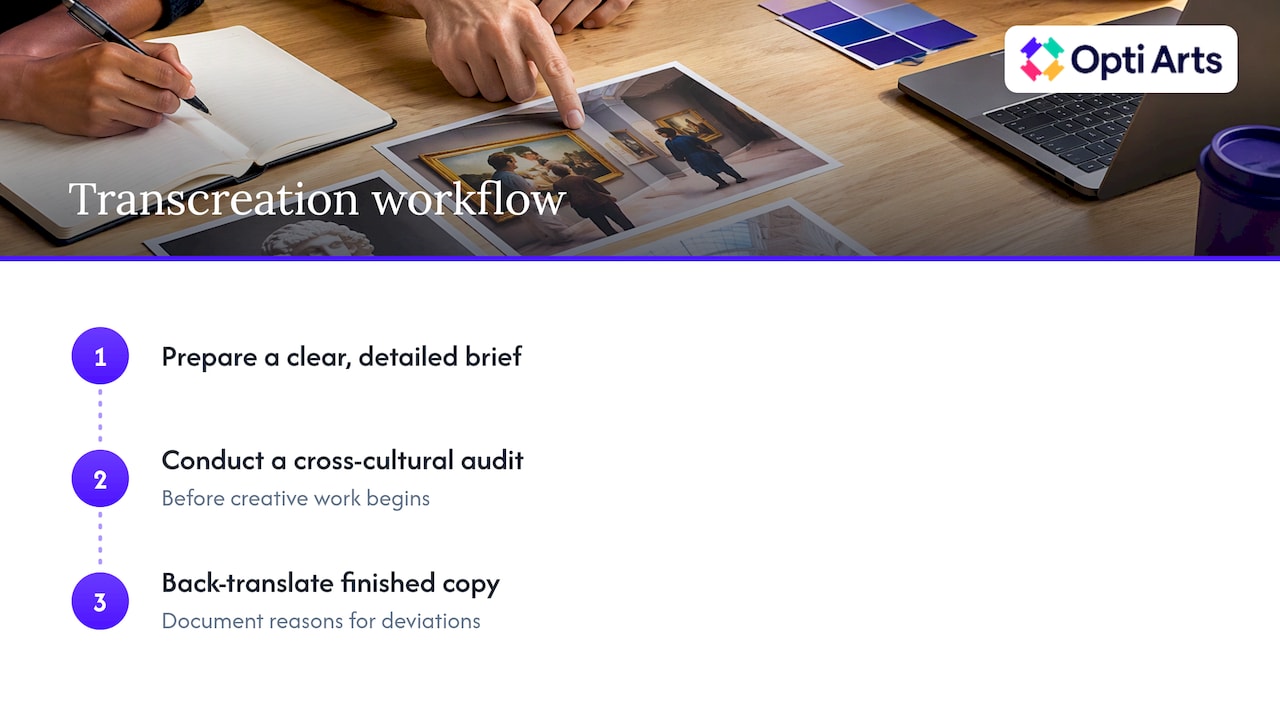
Brief them properly. The ITI’s transcreation code of practice says no transcreation should start without a clear, detailed brief, and calls for a cross-cultural audit before creative work begins, plus back-translation with reasons for any deviations.
Show the translator the ad. Translators need to see where the ad will appear and where it leads if clickable. Machine translation copes with straightforward content, but clever phrasing is lost.
Keep the copy simple. Multicultural NSW’s playbook advises writing at a reading level around age 9 and avoiding puns, colloquialisms and acronyms. That advice also suits a three-second scroll on a phone.
Sometimes translation is not enough
AAM’s Jill Kushner Bishop points out that some communities expect content created for them, not a translation of English material. If your English ad leans on a joke, a seasonal reference or a local in-group phrase, write a new concept in the second language instead. Test creative variants in each language and let results decide.
Examples from museums that did it
The Exploratorium in San Francisco ran ads for its ¡Plantásticas! exhibition in Chochenyo, Spanish and English. BART ran the first train and station ads in Chochenyo, the language of the East Bay Ohlone, and the ads also ran in the San Francisco Chronicle and San Francisco magazine. The copy was written in Spanish first, then translated into English, with Chochenyo translations by community members.
San Francisco’s Museums for All program took a different route. It sent English, Spanish and Chinese postcards to more than 100,000 households receiving public benefits, ran more than 1,000 bus ads in the three languages with ad space provided free by SFMTA, and added a paid multilingual social media campaign.
The lesson: the order of languages and the choice of channel are editorial decisions, not afterthoughts.
Choose channels where the audience already is
AAM’s guidance describes a range of options, from labels and visitor guides on limited budgets to audio guides, video voiceovers, websites, promotional texts and brochures on larger ones. For paid advertising, the same logic applies: start narrow, expand when you see results.
A practical channel map for a museum marketing team:
Channel | How bilingual creative helps |
Meta (Facebook, Instagram) | Language and interest targeting, and separate creative variants per language. See our guide to Facebook ads for museums with Pixel and CAPI. |
Google Search | Spanish-language keywords and ad copy capture people searching in their own language. |
YouTube and Connected TV | A dubbed or subtitled exhibit trailer. Our video ads playbook covers formats. |
Spotify and digital audio | Spoken ads feel natural in a language people already listen to. |
Display | Language-matched banners that send people to a matching landing page. |
These are the channels we run for cultural organizations, and a single plan can coordinate them so each language gets the right mix instead of a copy of the English buy.
Make the whole path bilingual
An ad that promises Spanish and lands on an English-only page loses the visitor. The Texas Historical Commission’s bilingual guide for museums advises being strategic about which resources to translate given costs, and designing so visitors can self-select what works best for them, without feeling othered.
In practice, check each step after the click:
A landing page in the ad’s language, with the exhibit, hours, price and a clear button.
Directions, accessibility and parking information in the same language.
A ticket path that does not break the experience. One museum in the AAM case study noted that tickets could not yet be purchased in Spanish, so plan for that gap with clear instructions on the landing page.
On site, something to match the promise: Spanish QR-code guides, paper guides, bilingual staff or volunteers on the floor, as that museum tested.
For a wider view of how ads, site and visit connect, see our ticket-first exhibition marketing plan. If your site is also going bilingual, this guide to setting up English and Spanish website SEO covers the technical side.
Measure each language as its own audience
A blended report hides what works. Set up tracking so every language is its own line.
Separate campaigns or ad sets by language, with distinct names, so spend, clicks and cost per click are comparable.
Use language-specific landing pages or URL parameters, so you can see who arrived from which ad.
Connect ad clicks to ticket sales. The platform’s own click report is not the same as tickets sold. Pixel and server-side tracking can pass purchase events back; our Meta guide shows how.
Compare cost per ticket and return on ad spend by language, not just click-through rate.
Ask at the door or at checkout how visitors heard about you, in both languages.
This is where Breakeven, our ticket sales tracking dashboard, fits. It is platform-agnostic, supports all ticketing providers, and shows performance across channels in one place, so you can see whether the Spanish campaign sells tickets as well as the English one, or better.
Perspective
Most museums we talk to treat a second language as a favor to a small group, so it gets the leftover budget and a translated copy of the English ad. That framing is the problem. A Spanish-speaking household near your museum is an audience with its own habits, its own platforms and its own reasons to come. Our approach is to build the plan around that audience: its own creative, its own targeting, its own line in the report. When every channel feeds one dashboard tied to ticket sales, the question stops being whether bilingual ads are worth it and becomes which language, which channel and which exhibit gives you the best return. That is a question a marketing team can answer with data and act on before the next curtain-up date. Trevor
Where Opti Arts fits
If you want bilingual campaigns planned, launched and tracked by a team that works only with cultural organizations, we build custom strategies around your goals and budget across Meta, Google, YouTube, Spotify, Connected TV and display. Explore our advertising solutions, or see how Breakeven tracks real-time ticket sales across channels.
If your team is small, our museum marketing strategies for small teams outlines a six-week start.
FAQ
Should we translate everything or start with one language?
Start with one language and your most popular exhibit or program. AAM’s guidance recommends prioritizing popular exhibits when budgets are limited. Once you see cost per ticket for that audience, add languages in the order your community data supports.
Is machine translation good enough for ads?
It handles plain, factual lines, but wordplay and tone are often lost. For ads, have a native-speaker translator adapt the message and check it against the placement and landing page. Keep a glossary so names and terms stay consistent.
Which languages should a museum advertise in?
Use your own data: staff and visitor surveys, local demographics and your exhibit’s cultural appeal. Spanish is the likely first choice for most US museums, but regional communities may call for others, such as Somali or Hmong in Minneapolis.
How do we know bilingual ads are selling tickets?
Give each language its own campaign, landing page and tracking, then compare tickets sold and cost per ticket rather than clicks alone. Connecting ad platforms to your ticketing system makes that possible in one view.
Sources
Recommended