

Hulu Ads for Nonprofits: A Guide for Arts Marketers


Yes, nonprofits can advertise on Hulu, and for a theater, museum or concert venue it is one of the few places where a 30-second video can reach a household at home, on the biggest screen in the room. Hulu reviews nonprofit and charitable advertisers case by case rather than banning them, and the campaign is only worth running if you can tie it to tickets sold. That is the part we build for arts organizations through our Connected TV service and our Breakeven dashboard.
TL;DR
Hulu’s own advertising guidelines treat nonprofit and charitable advertisers as reviewable case by case, not as prohibited.
Hulu’s ad-supported plans show ads before and during shows, so your spot appears inside content people chose to watch.
Creative is the make-or-break piece: open with impact, carry one message, and give the call to action time to register.
Cost is driven by your budget, the audience you target and the number of delivered impressions, so plan backward from the tickets you need to sell.
Measure against box office data, not views alone. Real-time ticket tracking is what tells you whether to keep spending.
Table of Contents
Does Hulu take nonprofit ads?
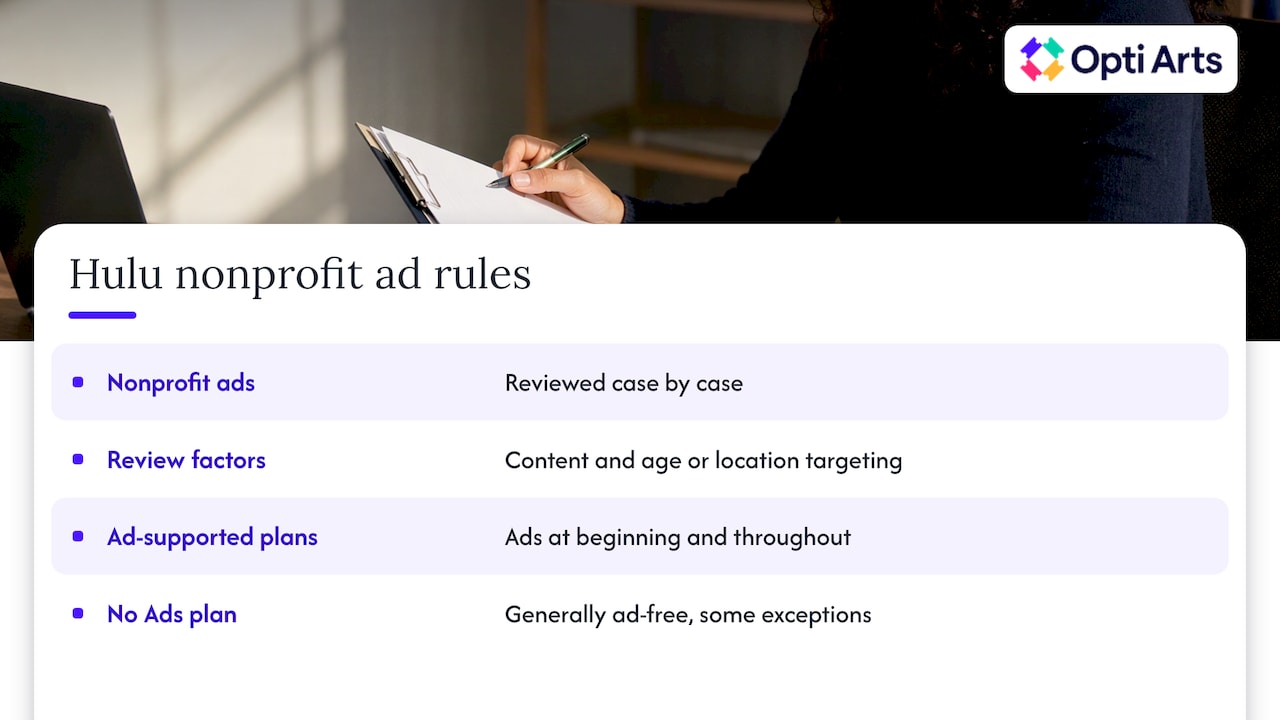
It does. Hulu’s U.S. advertising inventory guidelines, published by Disney Advertising in July 2024, say government, nonprofit, nongovernmental and charitable advertisers, including public service announcements, are reviewed on a case-by-case basis. Reviewers look at factors such as content appropriateness and any age or location targeting restrictions.
For an arts group, that means a season announcement, a new exhibition or a single-night engagement is the kind of message that fits. It also means you should expect a review step before your spot runs, so build it into your timeline rather than uploading a file the week before curtain-up.
Where do the ads appear? Hulu’s help center explains that ad-supported plans show ads at the beginning of and throughout shows and movies, while the No Ads plan is generally ad-free, with some exceptions. Your audience is the ad-supported viewer, which is a lean-back, full-screen environment very different from a social feed.
Why streaming TV suits cultural organizations
Most arts marketers already know the problem: the people most likely to buy a ticket are not always the people who follow you. Social ads reach people mid-scroll. A streaming spot on a television screen gets sound, motion and a full-frame image, which is exactly what a stage production or a gallery exhibition needs to look like.
Three reasons it works well for ticketed events:
The format matches the product. Theater and music are sound-and-motion experiences. A trailer on a TV screen carries far more of that than a static banner.
Targeting narrows the waste. You can aim at households near your venue rather than paying to reach the whole country, which matters when the event is a single run in one city.
It extends your mix. Streaming TV is strongest alongside search and social. Someone who sees your trailer on a TV and later searches your show title is the audience your Google and Meta campaigns are built to capture.
We go deeper on this in our streaming TV guide for arts groups and our walkthrough of connected TV ads for nonprofits.
What a Hulu campaign costs
There is no single price for a 30-second Hulu spot, and anyone quoting one flat figure is simplifying. Streaming ads are sold on impressions, meaning each time an ad is delivered to a viewer, and the total depends on how many impressions you buy, how narrowly you target and when the campaign runs.
Some facts that are stable:
Disney’s self-serve platform, Disney Campaign Manager, states that campaigns start at $500, with no subscription, setup or installation fees.
According to its billing FAQ, advertisers pay by credit card and are charged only for impressions actually delivered after the campaign goes live.
Those are entry points, not a plan. A $500 flight in a large market may deliver a modest number of impressions, and a single burst rarely moves a ticket count. Our advice is to set the budget by working backward:
Step | Question to answer | Example |
1 | How many seats do you need to fill? | 600 unsold seats across a six-performance run |
2 | What is your average ticket revenue? | Use your own box office average |
3 | What can you afford to spend per ticket sold? | A share of that average, set by your finance team |
4 | What does that allow in total media spend? | Seats to fill times your acceptable cost per ticket |
5 | How much goes to streaming versus search and social? | Split by the role each channel plays |
The numbers in the example column are placeholders. Put your own box office data in, because your acceptable cost per ticket is the figure that makes every other decision easy.
Our guide to higher return on ad spend covers how to set those targets.
The review and creative rules to plan for
Streaming ads are held to broadcast-style standards. Before you commission anything, know what Hulu will check.
What Hulu requires
From the inventory guidelines:
Ads must be in English or Spanish. Ads submitted through Disney Campaign Manager must be in English only, for technical reasons.
Advertisers using Disney Campaign Manager may not direct advertising to children under 13. That matters for family programming and youth theater: aim your targeting at parents and adults.
Offers must be truthful, claims need substantiation, and disclosures must be clear and conspicuous. If you say “sold out” or “best-reviewed,” be ready to support it.
Third-party tags, pixels or code need Hulu’s prior written approval, so tracking setup should be settled early.
For technical specs and creative decline materials, the official place to look is the Hulu Media Kit, which holds the ad specs and standards for every ad that runs on the platform.
What makes the spot work
Disney’s own guide to creating streaming TV ads gives advice that fits arts marketing well. It says to open with impact, begin and end with the brand, deliver one clear message, use voiceover or on-screen text, and give the on-screen call to action enough time to register. It also warns against still imagery and slideshow-style creative.
Translated for the stage and the gallery:
Win the first three seconds. Start on the most arresting moment: the lead character mid-gesture, the orchestra’s first swell, the object visitors will talk about.
One show, one message. A season brochure read aloud is not a spot. Pick the production or exhibition with the most room to grow and give it the whole 30 seconds.
Name the venue at the start and the finish. Viewers see dozens of ads in a night. If they remember the show but not where it plays, the spot did half its job.
Make the call to action specific. A date, a place and one action: “Tickets for the March run at your venue’s site.” Leave it on screen long enough to read twice.
Skip the slideshow. Production photos with a voiceover look like a flyer on a TV. Use real footage, even cut from rehearsal or a trailer your company already has.
We have laid out what works in more detail in ad creative for theater, and for exhibitions in video ads for museum exhibits. When you are weighing who should produce and test creative, the principles in this guide to testing conversion claims honestly are a useful frame for what a fair test looks like.
Build several creative variants, not one. A 30-second cut, a 15-second cut and two different opening shots give the ad delivery system real options, and give you data on which story sells.
Who to target
For a performing arts audience, think in layers rather than one big audience.
Local households. Geography is your strongest filter. A regional theater has no use for impressions three states away.
Past buyers and lookalikes. Your ticketing history is your most valuable audience data. It sharpens who sees the ad and who does not.
Interest and content signals. Viewers of drama, music and documentary programming tend to line up with arts audiences, though you should let results, not assumption, decide what stays.
Retargeting through other channels. Someone who watched your spot and then searches your title on Google is a warm buyer. Make sure your search campaign is live while the TV flight runs.
Keep targeting within the platform’s rules, including the under-13 restriction above, and check that any data you use for audience building complies with applicable U.S. privacy law.
Measure tickets, not just views
Streaming TV tends to be judged on completion rate and reach. Those matter, but a board member asking “did it sell tickets?” will not be satisfied by a completion rate.
What we would track for every flight:
Ticket sales by day against the dates the campaign ran.
Sales by channel so you can see how TV, search and social work together instead of fighting for credit.
Cost per ticket sold against the target you set during budgeting.
Sell-through pace relative to the same point in past runs.
Creative variant results so the next flight starts smarter.
This is where our Breakeven dashboard fits. It tracks ticket sales in real time, is built to work with ticketing systems, and is platform-agnostic, so the question “is it working this week?” has an answer while there is still time to shift budget.
Our piece on theater digital advertising explains the two moves that tie ads to ticket sales, and it applies to a streaming flight as much as to a social one.
A practical flight plan for a six-week run
If you have a show opening and want a structure to borrow:
Weeks one and two, before on-sale momentum fades: introduce the production with your strongest 30-second spot, tightly targeted to your region.
Weeks three and four: add a shorter cut and your second creative variant. Keep search live to catch people who go looking.
Weeks five and six: shift weight toward the formats and audiences that produced tickets, and add a last-chance message with the dates and remaining performances.
After closing, review the results by variant and by channel, and carry the lessons into the next production.
Arts marketers rarely have a shortage of ideas. What most lack is a clear line between the ad and the ticket. A Hulu spot can be beautiful and still leave you guessing about what it did. We build campaigns for cultural organizations around that line. We start from the seats you need to fill and the budget you have, choose the platforms that fit, from Connected TV to Google, YouTube, Meta, Spotify and display, and then track the results against ticket sales in one dashboard that works with any ticketing provider. Our approach is designed to keep strategy custom to your goals and budget, because a 300-seat black box and a 2,000-seat hall should not run the same plan. Nonprofit does not have to mean small thinking. It means every dollar has to be accountable, and that is the standard we hold campaigns to. Trevor
Our view: build the plan around the box office
Working with Opti Arts
We are a digital marketing agency built for cultural organizations. For streaming TV, our Connected TV service sits alongside Meta, Google Search, YouTube, Digital Audio and Display, all planned around your goals and budget, with Breakeven showing ticket sales as they happen. If you want a campaign that connects the trailer to the box office, that is the work we do.

To see how it would apply to your next production or exhibition, start with our solutions page.
FAQ
Does Hulu run ads?
Yes. Hulu’s ad-supported plans show ads at the start of and during shows and movies, while its No Ads plan is generally ad-free with some exceptions, according to Hulu’s help center. For advertisers, that means your spot reaches viewers who chose the ad-supported tier.
Can a nonprofit arts organization advertise on Hulu?
Yes. Hulu’s guidelines say nonprofit, charitable and public service advertisers are reviewed case by case. Plan for creative review, English-language ads on Disney’s self-serve platform, and targeting that does not direct advertising to children under 13.
How much does a 30-second Hulu ad cost?
There is no flat price per spot. You pay for delivered impressions, so cost depends on your budget, targeting and timing. Disney’s self-serve campaigns start at $500, and the right figure for you comes from the number of tickets you need to sell and what you can spend per ticket.
How do I know if Hulu ads sold tickets?
Compare daily ticket sales against the flight dates and your other channels. A dashboard connected to your ticketing system shows this as it happens, which is what Breakeven is built for.
Sources
Recommended