

Retention First Audience Development Strategy for Cultural Marketers
- Cam Collier
- 4 days ago
- 9 min read


An audience development strategy is a documented, evidence-driven plan that prioritizes retention and community to grow engaged, high-value audiences. It works only when it replaces guesswork with research, treats existing supporters as more valuable than new prospects, and ties every tactic back to a measurable business goal. The rest of this guide breaks down the frameworks, research methods, and 30/90/180-day roadmap that make that plan real.
TL;DR:
Focusing on retention and community-building creates a more engaged audience than solely pursuing new prospects or quick ticket sales.
Gathering audience insights through surveys, interviews, social listening, and analytics helps in developing actionable segmentation and targeted tactics.
Prioritizing retention before acquisition and testing strategies against the 4 Cs framework ensures sustainable growth and deeper audience relationships.
Tracking key outcomes such as retention rate, repeat visits, engagement, and lifetime value provides more meaningful insights than vanity metrics.
A phased, data-driven approach that sequences audits, pilots, and scaling ensures effective use of budget and continuous measurement.
Table of Contents
What Is an Audience Development Strategy, and How Is It Different From Marketing?
Marketing sells a specific offer to whoever will listen. Audience development builds the relationship that makes every future offer land better. It is the difference between running a campaign for next month’s show and building a base of people who show up season after season, tell their friends, and forgive you when a performance sells out and they can’t get in.
The goals look different too. Where a marketing plan chases ticket sales for a single event, an audience development plan tracks engagement, retention, revenue per relationship, and inclusion across your entire community. A donor who attends twice a year and brings a guest each time is worth more, over time, than three one-time buyers who never return.
This is why a documented plan matters. The Audience Agency frames it as a “route-map for change,” a working document that ties programming, marketing, and community engagement together instead of letting each department chase its own numbers. Without that map, teams end up optimizing for different things and calling it strategy.
The 4 Cs Framework for Audience Development
Most successful audience programs, whether at a regional theater or a natural history museum, run on some version of four principles: Community, Connections, Collaborations, and Caring.
Community means building a sense of belonging around your organization, not just around individual events. People return to places where they feel like insiders.
Connections covers the relationships between your organization and the people in it, plus the relationships those people build with each other.
Collaborations are the partnerships with other organizations, artists, or community groups that extend your reach without inflating your ad budget.
Caring is the follow-through: how you treat people after they’ve bought a ticket or made a donation, which determines whether they come back.
Layer two operating principles on top: retention comes before acquisition, and every decision gets tested against evidence rather than instinct. Say you’re deciding between launching a new membership tier or running a broader awareness campaign. A 4 Cs lens pushes you toward the membership tier first, because it strengthens Community and Caring for people you already have, while the awareness campaign only pays off if your retention systems can actually hold onto the new names it brings in.
How Do You Gather Evidence for an Audience Strategy?
Evidence beats opinion every time, but you don’t need a research department to get it. Five methods cover most of what a mid-sized cultural organization needs: surveys sent to your existing list, short interviews with a handful of loyal patrons, social listening on the platforms your audience actually uses, web analytics on your ticketing and donation pages, and cohort analysis that tracks how different groups of first-time attendees behave over their first year.
Statistic to know: a majority of media and cultural organizations operate without a formal, documented audience strategy, according to Omeda’s audience planning research. That gap is your opening. Formalizing even a rough plan puts you ahead of most peers.
Structure your research to move fast:
Write down three to five assumptions about your audience before you collect any data.
Rank them by how much budget or programming they’d change if proven wrong.
Test the top two with the cheapest method available, usually a survey or a round of five interviews.
Set a two-week deadline. A slow answer is often worse than an imperfect one.
How Do You Segment Your Audience Into Actionable Personas?
Raw research becomes useful only when you turn it into segments a program manager can act on. Build segments along four axes: motivation (why they engage), behavior (how often and through which channel), value (revenue or advocacy contributed), and lifecycle stage (new, active, lapsing, lapsed).
Pull the data. Combine ticketing history, email engagement, and survey responses into one view per contact where possible.
Cluster into three to five segments. More than five and no one on your team will remember what makes each one distinct.
Write a one-page profile per segment. Include what they need from you and their “best next ask,” meaning the single most logical next step, whether that’s a membership upgrade, a volunteer invite, or simply another visit.
Assign an owner. A segment with no one responsible for it will not get acted on.
A lapsing subscriber segment’s best next ask might be a personal check-in call, not another discount email. A first-time attendee segment’s best next ask is usually a low-friction return offer within 30 days, while a high-value donor segment’s next ask could be an invitation to a behind-the-scenes event rather than another appeal letter.
What Tactics Actually Grow an Engaged Audience?
Picture your audience as water in a bucket with a hole in the bottom. Every acquisition campaign pours more water in, but if the hole is big enough, you’re just running to stand still. That’s the leaky-bucket principle, and it’s why retention has to come before scale. A smaller, highly engaged community consistently outperforms a large, passive following on revenue and advocacy, even though it looks less impressive in a follower count.
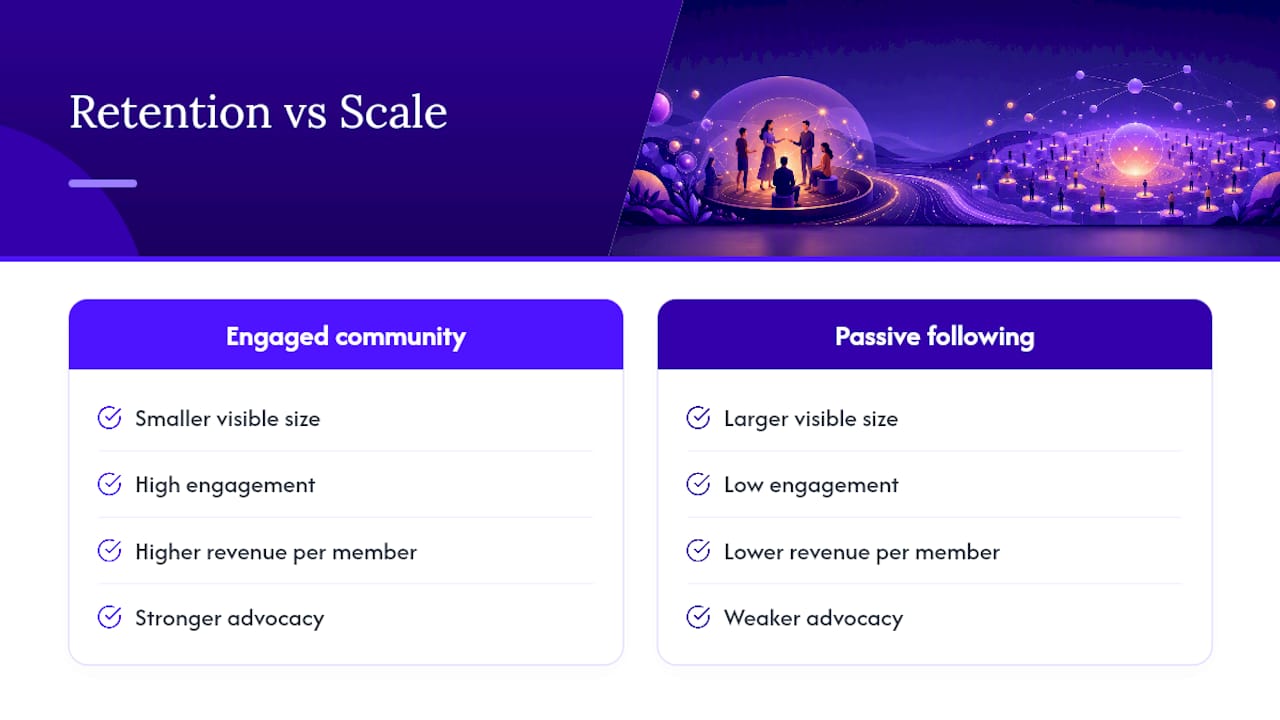
Community tactics. Memberships and subscriber programs give people a reason to return regularly rather than transactionally. Volunteer programs turn casual attendees into invested stakeholders. Owned platforms, like an email list or a members-only online community, matter more than they get credit for, because they’re the only channel you don’t rent from an algorithm.

Content and distribution. Consistency in posting cadence matters more than sheer frequency. A predictable rhythm, say, a Tuesday newsletter and a behind-the-scenes video every Thursday, prevents audience fatigue better than an aggressive but erratic schedule. Repurpose your best content across formats: a rehearsal photo becomes a Meta ad, a Spotify playlist teaser, and a YouTube short without triple the production cost. Prioritize the platforms your segmentation data says your audience actually uses, not the ones your team personally prefers.

Activation. Paid targeting across Meta, Google, and streaming TV works best once your retention systems are solid enough to hold onto the new attention it generates. Programmatic advertising can extend reach efficiently, and partner co-promotions with adjacent cultural organizations or local businesses often outperform paid media on cost per engaged new contact. Influencer collaborations work well for cultural organizations when the influencer’s existing audience already overlaps with your ideal segment, rather than being chosen for follower count alone.
Pro Tip: Before increasing acquisition spend, calculate your current retention rate. If fewer than half of first-time attendees return within a year, fix that leak before you pour more people into the bucket.
What KPIs Should You Track for Audience Development?
Vanity metrics like total followers or impressions feel good in a board meeting and tell you almost nothing about whether your strategy is working. Track outcomes instead.
Retention rate: the percentage of last year’s active audience still active this year.
Repeat visit rate: how often the same person returns within a defined window.
Engagement rate: opens, clicks, event RSVPs, and community participation, weighted by channel.
Lifetime value per segment: revenue and advocacy value attributed to each persona over time.
Conversion funnels: where prospects drop off between first contact and first purchase.
Statistic to know: returning visitors convert at meaningfully higher rates than new visitors, which is why engagement functions as a leading indicator of long-term revenue rather than a soft, secondary metric.
Map each KPI to a SMART objective (specific, measurable, achievable, relevant, time-bound) rather than tracking numbers in isolation. Report weekly on fast-moving signals like email opens and ticket velocity, and monthly on slower trends like retention rate and lifetime value. A clear attribution model keeps your team from crediting a sale to the last channel touched when three earlier touches actually did the work.
How Do You Plan and Budget an Audience Development Strategy?
Treat your strategy on three timelines at once. A three-year ambition sets the destination, an annual plan sets the milestones, and quarterly experiments let you test new tactics without betting the whole budget on an unproven idea.
Set SMART objectives per timeline. A three-year goal might be “grow the retained membership base by a defined percentage.” An annual goal breaks that into quarterly targets.
Split budget into sustain versus experiment. Most of your spend should protect what already works; a smaller, fixed slice funds new tactics you’re testing.
Assign governance. Name who owns retention, who owns acquisition, and who reviews cross-team results monthly so programming, marketing, and community teams stay aligned rather than duplicating effort.
How Opti Arts Applies This in Practice
Opti Arts has run data-driven, cross-channel campaigns for theaters, museums, and performing arts venues, combining Meta, Google, YouTube, Spotify, and streaming TV placements with a real-time ticket sales tracking dashboard. Clients working with Opti Arts report improved return on ad spend and higher event attendance after moving from ad hoc promotion to a documented, segmented approach.
Three lessons carry across every engagement. First, retention data should shape creative before a single ad is built, not after. Second, a dashboard that shows performance in near real time lets you shift budget mid-campaign instead of waiting for a postmortem. Third, cultural organizations that pair paid advertising with community-building consistently outperform those running paid media in isolation.
Your 30/90/180-Day Action Plan
You don’t need a finished three-year plan to start. You need a sequence.
Days 1 to 30: Audit your current data (ticketing, email, social) and identify your top three assumptions about your audience. Align stakeholders across programming, marketing, and development on shared goals. Ship one quick win, like a re-engagement email to lapsed attendees.
Days 31 to 90: Run segmented pilots against your top two or three personas. Seed a small community initiative, whether a members-only event or a volunteer cohort. Measure retention and engagement weekly, not just at the end.
Days 91 to 180: Scale whichever pilot performed best, reallocate budget away from what underperformed, and embed your KPI dashboard into a recurring reporting cadence so measurement doesn’t lapse once the initial push ends.
Pro Tip: Resist the urge to run all three phases in parallel. Sequencing forces discipline, and a 30-day audit done properly will save you from scaling the wrong pilot at day 90.
Where to Find Templates and Deeper Guides
For hands-on tools, Omeda’s audience strategy and planning guide offers a useful starting framework. The Audience Agency’s planning guide walks through the route-map approach in more depth, and the Wallace Foundation’s case comparisons show five organizations solving the same problem five different ways.
Why Retention-First Thinking Beats Most Conventional Advice
The research behind this guide points to an uncomfortable truth: most organizations still build strategy around acquisition because it’s easier to show a board a bigger number than a healthier relationship. That’s backward. The Wallace Foundation’s case comparisons make clear there’s no universal tactic set, but every organization that succeeded treated its existing audience as the foundation, not the afterthought.
Conventional advice tends to front-load channel selection: which platform, which ad format, which influencer. That’s the wrong starting question. The right one is whether your retention systems can hold onto the attention you’re about to buy. Skip that step and you’re just filling a leaky bucket faster.
If you take one thing from this guide, prioritize the segmentation work before the tactics. A persona without a defined “next ask” is decoration, not strategy. Get that operational detail right, and the channel choices get a lot easier to make.
— Trevor
Turn This Strategy Into a Real Campaign With Optiarts
Optiarts is the specialist alternative to a general-purpose agency for cultural organizations that need retention-first thinking baked into every campaign, not bolted on after the fact. Where most agencies optimize for ticket sales in isolation, Optiarts builds data-driven campaigns across Meta, Google, YouTube, Spotify, and streaming TV specifically for museums, theaters, and performing arts venues, backed by a real-time analytics dashboard that shows what’s driving attendance while a campaign is still running.
That means you’re not waiting for a monthly report to find out a segment underperformed. You see it, and you shift budget while it still matters. Clients report stronger return on ad spend and higher attendance once their campaigns reflect the segmentation and retention priorities this guide covers. If you’re ready to see what a tailored campaign strategy looks like for your organization, reach out to Optiarts and start the conversation about your next season.
Sources
Recommended