

Measure First: Dynamic Creative Optimization Tested for Ticket Sellers


Dynamic creative optimization (DCO) is a technology that assembles ad creative in real time from modular components, matching headlines, images, and offers to each viewer’s data signals. Its payoff is relevance at scale: higher click-through and conversion rates without building thousands of ads by hand. DCO earns its place in your stack once you have structured product feeds and enough conversion volume to feed its decisioning engine, typically for retargeting, catalog-heavy retail, or any campaign with more audience segments than your creative team can service manually.
TL;DR:
Effective DCO campaigns require structured product feeds, reliable data signals, and creative templates designed for variability to avoid failures.
Personalization scope should be limited to essential segments and assets to reduce complexity and ensure templates can handle longer or unexpected content.
Combining predictive scoring, adaptive testing, and high-quality feeds yields performance lifts of around 36% to 47%, especially when traffic is finite.
Privacy compliance demands first-party data, server-side tracking, and careful feed hygiene to avoid misattribution and legal issues across jurisdictions.
Budgeting should account for scalable asset production, ongoing feed maintenance, and testing reserves to avoid overspending on underperforming variants.
Table of Contents
What Is Dynamic Creative Optimization and How Does It Differ From Static Ads?
Dynamic creative optimization builds ads from a library of interchangeable parts rather than a single fixed design. A template defines the layout; placeholders inside it swap in headlines, product images, prices, or calls to action depending on who is viewing the ad and where. Wikipedia describes DCO as the real-time assembly of personalized ad variations using audience and contextual signals, which is a useful baseline definition, though the practical version marketers deal with adds a layer of measurement most references skip.
Static creative is one ad, one message, shown to everyone. Programmatic buying, by contrast, automates where an ad runs and how much you pay for it. DCO automates the content of the ad itself. The three work together but solve different problems: programmatic finds the right eyeballs, DCO puts the right message in front of them.
Three components make DCO function: an asset library holding every headline, image, and offer variant; data feeds carrying product, pricing, and inventory information; and a decisioning engine that picks which combination to render for a given impression. Miss any one piece and the system degrades to expensive static creative with extra steps.
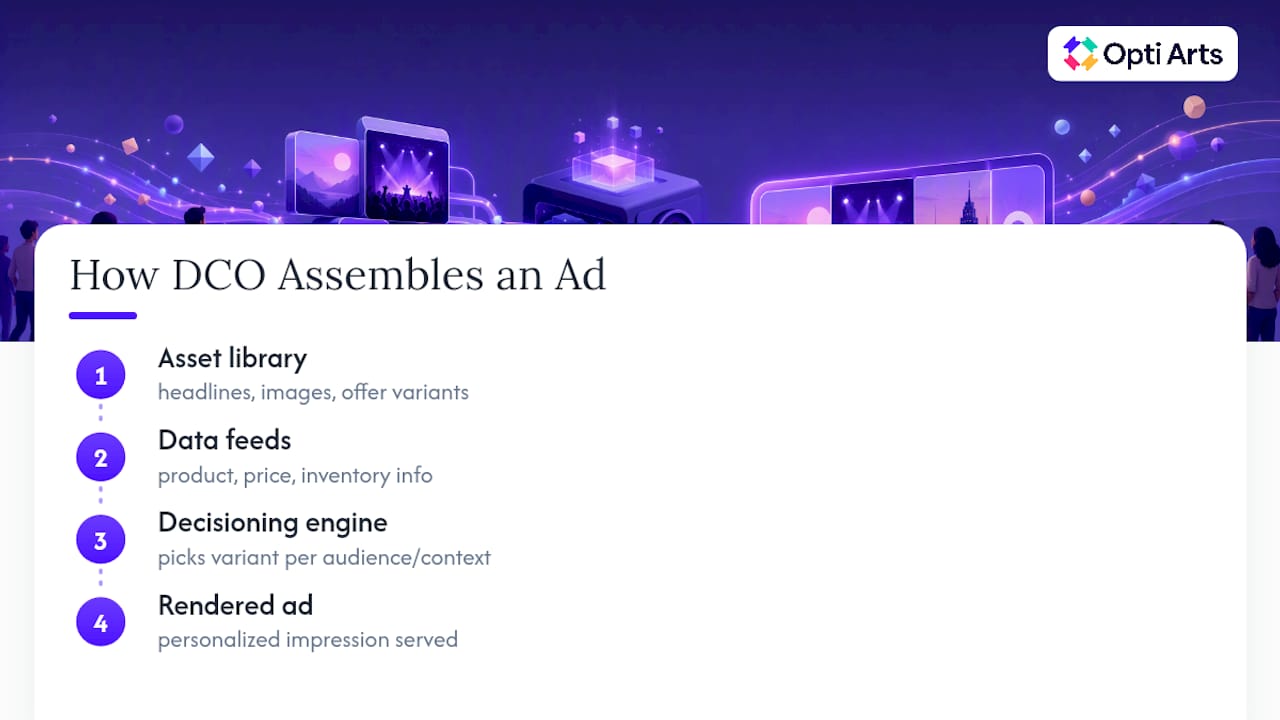
How Does DCO Work Behind the Scenes?
The pipeline starts with data. First-party pixel data tells the system what a visitor already viewed or abandoned. Product and inventory feeds supply live pricing, stock levels, and promotional flags. Contextual signals add another layer of targeting logic on top of who the viewer is.
Templates translate that data into visuals. Each template defines placeholders for text and images, along with fallback values for when a data field is missing or a feed returns a null. Multi-size asset requirements complicate this further: a template built for a 300x250 banner needs a parallel structure for a 970x250 leaderboard or a vertical mobile unit, and headline lengths that fit one rarely fit all three cleanly.
Decisioning is where the real optimization happens. Some systems use straightforward heuristics, show the highest-margin product in stock. More sophisticated setups run predictive scoring models that rank creative combinations by likelihood of conversion for a given user, then refine those predictions using an online feedback loop as real performance data comes in. Realize’s overview of DCO platforms frames this combination, modular assembly plus predictive AI plus feed integration plus outcome-focused bidding, as what actually drives measurable ROAS gains, provided the underlying feeds are clean and reliable.
Delivery is the final constraint. Your DSP or ad server has to render the assembled creative within tight latency windows, often under 100 milliseconds, while respecting each placement’s file size and format limits. A brilliant decisioning model is worthless if the rendered ad times out before the auction closes.
How Do You Set Up a DCO Campaign?
Running DCO well is a sequencing problem before it’s a technology problem. Skip a step and you’ll spend weeks debugging a symptom instead of the cause.
Define objectives and KPIs first. Decide whether you’re optimizing for ROAS, cost per acquisition, or a specific engagement metric before you build a single template. This shapes every downstream decision about which data signals matter.
Decide your personalization scope. Choose which audience segments, geographies, or product categories are worth the setup cost. Not every campaign needs ten variables of personalization; some need two.
Align stakeholders early. Creative, media buying, and analytics teams need shared assumptions about what’s being tested and measured before launch, not after the first performance review.
Build templates and prepare feeds. Map every field you’ll need, standardize naming conventions, and define fallback values for missing data. Amazon Ads’ DCO guidance recommends locking this structure down before touching media spend.
Implement tracking and QA rendering. Test every template across every placement size before launch. Validate that feeds populate correctly and that no placeholder ever renders blank.
Launch a test slate, then scale. Start with a manageable set of creative combinations, measure real performance, and expand the variants that win rather than the ones you assumed would win.
Where Does DCO Work Best? Examples Across Industries
DCO’s value shows up differently depending on what you’re selling and how urgent the offer is.
Retail uses DCO for product retargeting, showing the exact item a shopper viewed, along with inventory-aware messaging that swaps “in stock” for “3 left” as counts change.
Automotive and CPG brands swap feature callouts and localized offers, showing fuel economy in one region and towing capacity in another from the same base template.
Financial services tailors messaging by audience benefit, retirement planning language for one segment, low-fee checking for another, without building separate campaigns from scratch.
Cultural organizations personalize around inventory and timing: a theater can push a specific performance date to people who viewed it, then rotate in “final tickets” urgency messaging as a show nears sellout. This is closer to Opti Arts’s daily work than any retail example, since ticket inventory changes hourly and the creative needs to keep pace.
What Are the Best Practices for DCO Assets and Templates?
Most DCO failures trace back to templates that weren’t built for variability. A headline that fits at 40 characters in English breaks entirely once a longer product name or a special character gets pulled from a feed.
Keep headlines a consistent, short length, and test how special characters and encoding render across every placement.
Limit the number of fonts in a template and keep file sizes lean so ads load fast on both desktop and mobile.
Optimize image dimensions per ad slot rather than stretching one master image across every size.
Use hex color values for any dynamically inserted color field, and always define a fallback so a missing value doesn’t render a broken block.
Build an approval workflow that enforces brand constraints even as content changes automatically at serve time.
Google’s guidance on designing dynamic creatives covers most of this in more technical depth, and it’s worth a read before your first template build, not after your first rendering failure.
Pro Tip: Build your text fields around your longest expected value, not your average one. A template that looks clean with a 12-character product name will break the moment your feed pulls in a 40-character one, and that break usually happens in production, not in testing.
How Should You Measure and Test DCO Performance?
The smartest approach to creative testing doesn’t start with a coin flip between two ads. It starts with a predictive model that generates a high-recall slate, a wider set of candidate creatives likely to perform well, and then narrows that slate through adaptive online experiments rather than a single static A/B test.
This matters more than it sounds. An offline-to-online workflow combining generative creative candidates with predictive scoring and adaptive testing found field lifts of 36% to 47% for the best-performing creatives it surfaced. The bottleneck wasn’t generating enough creative options; it was evaluating them fast enough to act on the signal.

Track engagement and conversion rate as baseline metrics, but also watch incremental lift and experiment regret, how much performance you lose to weak variants while the test runs. Size your test slate to balance discovery against traffic loss: too few variants and you miss real winners, too many and you dilute traffic until no variant reaches significance. Batched adaptive allocation tends to outperform classical A/B testing whenever your slate is large and your traffic is finite, which describes most DCO campaigns.
How Does DCO Handle Privacy and a Cookieless Future?
DCO’s dependence on data makes privacy compliance a design requirement, not an afterthought. Prioritize first-party data collected with clear consent, and move tracking to server-side integrations wherever your platforms support it. Contextual triggers, page content, device, time of day, and aggregated audience cohorts fill gaps that third-party cookies used to cover, without tying creative decisions to an individual identifier. Feed and pixel hygiene matters more than ever here: a stale or duplicated feed doesn’t just hurt performance, it can misattribute conversions and quietly inflate the ROAS numbers you’re reporting to leadership.
What’s Next for Dynamic Creative Optimization?
Generative AI is changing DCO’s math. When a model can produce hundreds of headline and image variants in minutes, generation stops being the constraint and evaluation becomes it. Industry analysis of adaptive testing frameworks makes this point directly: the real skill going forward is using predictive models as generation critics, filtering candidates before they ever reach paid media, and running adaptive experiments to confirm what actually wins with real audiences. Expect DCO to keep expanding into video and connected TV, where dynamic overlays and localized offers are still new territory, alongside more cross-channel orchestration linking creative decisions across Meta, streaming audio, and display in a single logic layer.
What Should You Budget for a DCO Campaign?
DCO’s cost structure has more moving parts than a standard media buy, and underestimating any one of them is how pilot budgets blow past projections. Media spend is only the visible piece.
Template and asset production costs scale with personalization complexity. A campaign with three creative variants costs little more to produce than a static one. A campaign with fifty combinations across five audience segments, three product categories, and multiple placement sizes needs real design hours to build cleanly, plus QA time to verify every rendering path works.
Feed integration and maintenance carry an ongoing cost that’s easy to underbudget. Someone has to keep product feeds, pricing data, and inventory signals accurate and synced, and that’s a recurring operational line item, not a one-time setup fee. Platform or technology fees vary by provider and are frequently tiered by impression volume or the number of active creative combinations running simultaneously.
Testing and iteration require a media reserve set aside specifically for underperforming variants during the discovery phase. If you spend your entire budget assuming every variant will perform at the average, you’ll have nothing left when the top performers reveal themselves and you want to scale them faster. A practical rule: budget for your test slate as if half of it will underperform, because in most campaigns, it will. That reserve is what lets you shift spend toward winners in week two instead of waiting for the whole campaign to end.
How Should DCO Fit Into Your Broader Marketing Mix?
DCO rarely operates in isolation, and treating it as a standalone tactic is one of the more common strategic mistakes. Meta, Google, and streaming audio platforms each have their own attribution windows and modeling assumptions, which means a creative combination that looks like a winner in one platform’s dashboard might be getting credit that belongs to a different channel entirely in your broader funnel.
Cross-channel attribution models, whether multi-touch, data-driven, or a simpler last-touch approach, need to account for the fact that DCO-driven impressions often function as a mid-funnel nudge rather than the final conversion trigger. Someone might see a personalized product ad on display, then convert after a branded search, and a poorly configured attribution model will credit search entirely, hiding DCO’s actual contribution.
The fix is consistent, unified measurement rather than judging each channel by its own walled-garden numbers. Pairing DCO output with a cross-channel view of return on ad spend gives you a clearer read on whether personalized creative is actually driving incremental revenue or just reshuffling credit between channels that were already converting. Programmatic buying and DCO are natural partners here too, since programmatic infrastructure handles the delivery logic that DCO’s creative decisions depend on. Treat the two as one connected system when you build your measurement plan, not two separate reports that happen to sit next to each other.

What Regulatory Issues Should DCO Campaigns Watch For?
DCO’s reliance on personal and behavioral data puts it squarely inside data privacy regulation, and the compliance burden is heavier than most creative teams initially assume. Regulations like the EU’s GDPR and various US state privacy laws (California’s CCPA among them) govern how you collect, store, and use the signals that power personalization, and requirements differ by jurisdiction and by the category of data involved.
Consent management is the practical front line. If a user hasn’t consented to personalized advertising in a jurisdiction that requires it, your DCO system needs a compliant fallback creative ready to serve, not a broken render or a default to the most invasive version of your targeting. Financial services and healthcare-adjacent advertisers face extra scrutiny, since personalized messaging around sensitive categories can trigger additional disclosure requirements depending on the audience and the claim being made.
Data retention policies matter just as much as collection consent. Feeds and pixels that hold onto user-level data longer than necessary create both a compliance liability and a security exposure that has nothing to do with your creative strategy but everything to do with your legal one. Build your DCO data pipeline with deletion and audit capability from the start, because retrofitting compliance into a live feed architecture is far more expensive than designing it in. None of this is legal advice specific to your organization’s situation, and a compliance review from qualified counsel familiar with your jurisdiction and data practices should happen before any personalized campaign touches sensitive audience categories.
What Cultural Organizations Should Know About DCO
Opti Arts builds campaigns for museums and theaters across Meta, Google, YouTube, Spotify, and streaming TV, and the DCO logic above applies directly to ticket inventory. A show with shrinking seat counts needs creative that reflects that urgency automatically, not a static ad refreshed by hand every few days. Our Breakeven dashboard pairs that personalized delivery with real-time ticket sales tracking, so performance data flows back into campaign decisions instead of sitting in a separate report. For cultural clients specifically, the checklist that matters most: confirm your ticketing feed updates in near real time, decide which shows justify personalization spend versus a simpler evergreen ad, and align your box office team with whoever manages the creative before launch, not after opening night.
— Trevor
Ready to Put Dynamic Creative Optimization to Work for Your Venue?
Building a DCO pipeline from scratch means hiring for feed integration, template design, and predictive testing all at once, work most cultural organizations don’t have the bandwidth to staff internally. Opti Arts already runs that infrastructure for museums and theaters, applying the same personalization logic covered above to real ticket inventory across Meta, Google, YouTube, Spotify, and streaming TV.
Our Breakeven dashboard connects directly to your ticketing system, giving your team real-time sales data alongside campaign performance instead of two disconnected spreadsheets. Every campaign is built around your specific goals and budget rather than a one-size template, which is the same principle that makes DCO work in the first place: relevance beats volume. If your current advertising still relies on one static ad running to every segment, request a demo of our solutions and see what a personalized, measurement-first campaign looks like for your next season.
Sources
Recommended