

Cut CAC Under 15%: Event Marketing Funnel for Cultural Marketers


An event marketing funnel is the path a stranger walks from first hearing about your show or exhibition to buying a ticket and showing up. The metric that matters most is registration-to-attendance conversion, because it’s the one number that turns marketing spend into revenue or qualified leads. This guide breaks the funnel into five stages: awareness, consideration, decision, attendance, and retention, with the channels, budget, and benchmarks that move each one.
TL;DR:
Focus on retargeting, which converts at a much higher rate than cold paid social, and build audiences from the moment visitors land on the registration page.
Allocate roughly 8 to 15 percent of projected gross ticket revenue for marketing, with paid social making up 35 to 45 percent of the channel budget.
Track each funnel stage separately using metrics like registration-to-attendance rate, cost per registration, and engagement signals such as survey completion.
Prioritize reach for unproven or new events and shift toward conversion and retargeting after accumulating sufficient registrant data.
Use a detailed attendee journey map to identify and fix high-leverage friction points, especially the confirmation-to-arrival transition.
Table of Contents
What Are the Stages of an Event Marketing Funnel?
Every event marketing funnel moves a prospect through five distinct phases, and each one has its own job, its own metric, and its own way of quietly leaking your budget.
Awareness is where you introduce the event to people who’ve never heard of it. The goal is reach, not clicks. Success here looks like impressions, video completion rate, and branded search lift. The most common failure mode: running the same generic ad to everyone instead of splitting creative by audience segment, which flattens performance across the board.
Interest and consideration is where a curious stranger starts weighing whether this event is worth their time. Click-through rate and landing page engagement (time on page, scroll depth) are the metrics to watch. Funnels leak here when the landing page repeats the ad instead of adding new information, like a program lineup or seating chart.
Decision and registration is the moment of truth. The primary metric is registration rate, meaning the percentage of landing page visitors who complete checkout. Abandoned carts and long forms kill this stage more than anything else.
Attendance and engagement measures whether registered people actually show up and participate. Attendance rate (registrations divided into actual arrivals) is the number that separates a healthy funnel from a leaky one. No-shows spike when there’s no reminder cadence between registration and the event date.
Post-event and retention is where a single ticket buyer becomes a repeat customer or, in the B2B events context, a qualified sales lead. Common breakdowns include:
No follow-up within the first 24 hours, when response rates are highest
No mechanism to capture feedback or engagement data onsite
Treating the event as a one-off instead of feeding data back into the next campaign
Mapping Channels and Tactics to Each Funnel Stage
Matching the right channel to the right stage is where most event marketing strategy either pays off or quietly wastes money. Here’s how to sequence it.
Awareness: paid social and streaming audio. Meta and Spotify ad placements are built for reach, and with people spending multiple hours daily on social platforms, paid social remains the fastest way to introduce an event to a cold audience. YouTube pre-roll and Connected TV work well for season announcements or trailer-style creative that needs motion to land.
Consideration: content and paid search. Google Search Advertising captures people already typing “things to do this weekend” or a specific show name. Organic content (behind-the-scenes clips, artist interviews) builds trust before the ask.
Decision: landing pages and retargeting. This is where friction kills conversions. Cut registration forms down to name, email, and payment. Show real seating or ticket tiers instead of a generic “buy now” button, and offer a guest checkout so first-timers don’t abandon the process to create an account.
Attendance: email nurture and reminders. A confirmation email immediately, a logistics reminder three to five days out, and a final “see you tomorrow” reminder the day before all reduce no-shows. Retargeting ads aimed at registrants who haven’t opened emails catch the people who slip through.
Onsite: activations that capture data. QR code check-ins, digital program guides, and a simple post-show survey link turn a live event into a data source for the next campaign.
Pro Tip: Build your retargeting audience the moment someone lands on the registration page, not after they buy. That way you’re re-engaging warm visitors who almost converted, not just past customers.
Retargeting consistently converts at a much higher rate than cold paid social, which is why budget guides recommend funding it as a priority line item rather than an afterthought. Nurture emails should follow a simple cadence: confirmation, mid-cycle value-add (a lineup update, a parking tip), and a final countdown message. Skipping the middle touch is the single most common mistake in event nurture sequences.
How Much Should You Budget for Event Marketing?
Most established events should plan on spending 8 to 15 percent of projected gross ticket revenue on marketing, according to Ticket Fairy’s budget benchmarks. New events or first-year launches often need to push toward the higher end of that band, sometimes beyond it, simply because there’s no existing audience to retarget.
HubSpot’s research puts the broader picture in context: organizations typically allocate 10 to 20 percent of their overall marketing budget to events, and recurring events can run efficiently on 10 to 15 percent of the event’s own budget dedicated purely to promotion, once venue and production costs are set aside.
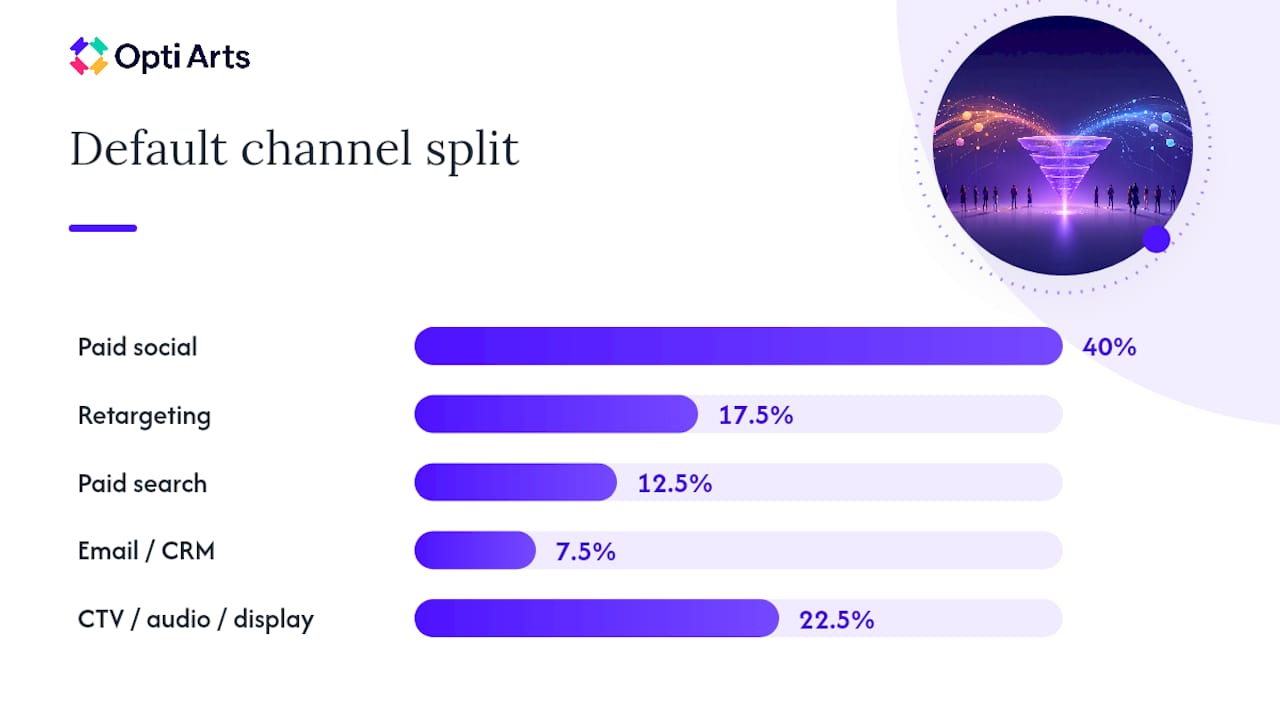
Default channel splits for a mid-size cultural event tend to look like this:
Paid social: 35 to 45 percent, carrying the bulk of awareness and consideration
Retargeting: 15 to 20 percent minimum, never cut below this floor
Paid search: 10 to 15 percent, higher for conferences or ticketed events with strong search intent
Email and CRM tools: 5 to 10 percent
Connected TV, digital audio, and display: the remainder, adjusted by audience and creative fit
A useful target for customer acquisition cost (CAC) is somewhere under 10 to 15 percent of average ticket price. If your average ticket sells for $40, a CAC creeping past $6 to $8 signals a leak worth investigating before you scale spend further.
Timing matters as much as amount. For an eight-week campaign, concentrate roughly 25 percent of the budget in the first four weeks and the remaining 75 percent in the final stretch, when urgency and retargeting both do their heaviest lifting.
Which KPIs Prove Your Event Funnel Is Working?
A working event marketing funnel needs a dashboard that tracks each stage separately, not one blended “marketing performance” number that hides where the leak actually is.
Awareness: reach, impressions, and video completion rate
Consideration: click-through rate and landing page engagement
Decision: registration rate and cost per registration
Attendance: registration-to-attendance rate, the single most telling number in the whole funnel
Post-event: engagement signals like survey completion, repeat purchase intent, and, for B2B events, pipeline attribution
Attribution gets messy fast without a plan. Set a UTM naming convention before launch (source, medium, campaign, stage) and connect first-party registration data directly to your CRM or ticketing platform so you can trace a lead from ad click to seat. Reviewing core web and campaign KPIs alongside event-specific metrics helps catch problems that a ticketing dashboard alone won’t surface, like slow-loading registration pages quietly suppressing conversion.
Run a full funnel review within 48 hours of the event while the data is fresh, then a deeper analysis at the two-week mark once post-event surveys and any pipeline movement have settled. A tool like Opti Arts’ analytics dashboard can pull reach, registration, and attendance into one view instead of forcing your team to reconcile numbers across five platforms.
How to Build an Attendee Journey Map That Fixes Real Problems
An attendee journey map only earns its place on your wall if it changes what your team actually does. Build one in five steps.
Pick one audience segment. Don’t map “all attendees.” Map first-time ticket buyers separately from season subscribers; their friction points differ completely.
Plot every touchpoint by stage. List the ad, the landing page, the confirmation email, the parking instructions, the check-in line, and the post-show survey in order.
Record the goal and the emotion at each touchpoint. A registrant checking their confirmation email wants reassurance. Someone in the check-in line wants speed.
Assign an owner to each touchpoint. Marketing owns the ad and email; operations owns the check-in line. Gaps happen when nobody owns the handoff between them.
Define a success signal for each fix. Before changing anything, decide what “better” looks like: fewer support emails, a faster check-in line, a higher survey response rate.
The confirmation-to-arrival transition is usually the highest-leverage fix: a clean confirmation email, a one-tap calendar add, and a QR code check-in. Test one change at a time and measure it against your attendance rate before adding the next.
Automation and AI Tactics Worth Piloting Now
The highest-return automations sit at the friction points your team already knows about: triggered reminder emails, progressive profiling on registration forms (asking one new question per visit instead of ten at once), and onsite check-in data flowing straight into your CRM instead of a spreadsheet someone updates next week.
AI applications worth testing on a small scale include predictive lead scoring for B2B events, automated no-show prediction that triggers a personalized reminder, and dynamic creative that swaps ad copy by audience segment. Pilot these on your single most frictional transition first, whether that’s cart abandonment or the confirmation-to-arrival gap, rather than trying to overhaul your whole stack at once. A narrow pilot with a clear before-and-after attendance rate tells you more than a platform-wide rollout ever will.
How Opti Arts Approaches the Event Funnel
The agency builds campaigns for museums, theaters, and performing arts venues across the channels this playbook covers: Meta and YouTube for awareness, Google Search for consideration, and Connected TV and digital audio for reach beyond traditional ticketing platforms. Each campaign is built around the client’s specific goals, budget, and audience segments rather than a one-size-fits-all template.
A dashboard tracks ticket sales and campaign performance in real time, integrated with ticketing systems, so marketing directors can see registration-to-attendance movement without waiting on monthly reports. Some clients report stronger return on ad spend and higher attendance, evidence that a stage-by-stage, budget-aware approach outperforms scattershot promotion.
Reach or Conversion: Which Should You Prioritize?
If your event is unproven or new, weight your budget toward reach. There’s no audience to convert yet. Once you have a season’s worth of registrant data, shift weight toward conversion and retargeting, because that data is worth more than any new impression.
Own your list early. Paid channels rent attention; email and CRM data compound. A funnel that spends its first year building an owned list will outperform one that spends every dollar on cold reach.
— Trevor
Ready to Put This Funnel to Work?
Building this playbook is one thing. Running it across Meta, Google, YouTube, Connected TV, and Spotify simultaneously, with a single dashboard showing what’s actually converting, is where most in-house teams hit a wall. Opti Arts exists specifically for cultural organizations that need bespoke campaigns aligned to their budget and goals, not a generic agency retainer built for retail brands.
The agency’s core services cover the exact channel mix this article walks through: Display Advertising and Digital Audio for early-funnel reach, Meta and YouTube Advertising for consideration and retargeting, and Connected TV for the kind of premium reach a season trailer deserves. Once campaigns launch, the Breakeven dashboard gives you registration-to-attendance tracking in one place, tied directly to your ticketing system, so you’re never guessing which stage is leaking.
If your funnel is leaking somewhere between registration and curtain-up, request a discovery conversation with Opti Arts to see where your budget is actually working, and where it isn’t.
Sources
FAQ
What Are the 5 Stages of the Marketing Funnel?
In an event context, the five stages are awareness, interest and consideration, decision and registration, attendance and engagement, and post-event retention. Each stage has its own metric, running from reach at the top down to registration-to-attendance rate as the funnel narrows.
What Are the 5 C’s of an Event?
Definitions vary across the industry, but a common version covers concept, coordination, control, culmination, and closeout, referring to the planning and execution side of running an event rather than the marketing funnel itself. Marketing teams should treat this as a production framework that runs alongside, not inside, the funnel stages described above.
Is a Marketing Funnel Outdated?
No. The linear funnel model still holds because ticket buying genuinely moves through awareness, consideration, and decision before someone shows up. What’s changed is the tooling: automation, retargeting, and predictive scoring now compress the journey between stages rather than replacing the underlying structure.
What Are the 5 P’s of Event Planning?
The common version covers purpose, people, place, product, and promotion, a planning checklist rather than a funnel model. Promotion is the piece that connects directly to the funnel stages covered in this article.
How Can Opti Arts Help With My Event Funnel?
Opti Arts builds paid media campaigns across Meta, Google, YouTube, Connected TV, and digital audio, mapped to each funnel stage from awareness through attendance. Pricing for services and the Breakeven dashboard is available directly through the agency.
Recommended