

One Page Event Marketing Plan for Cultural Marketers: T Minus Timeline


A usable event marketing plan is a one-page campaign that ties one or two SMART business goals to named audience segments, a T-minus timeline, a channel budget, single-owner accountability, and a 6 to 8 metric dashboard. Everything else is elaboration. Skip any of these five pieces and you get a scattered promotion effort instead of a plan, with templates and a T-minus schedule to build one below.
TL;DR:
Most event marketing plans should focus on one or two SMART goals, with specific metrics for tracking progress and success.
Audience segmentation into decision makers, repeat attendees, and new prospects is essential for targeted messaging and channel allocation.
A phased T-minus timeline from T-12 to T+4 ensures proper preparation, execution, and post-event follow-up, with benchmarks for early warning signs.
Budget should be aligned with channel strengths, prioritizing owned channels like email and advocacy over paid media, especially for warm audiences.
Clear ownership of tasks and live tracking setup before spend begins are critical to prevent common planning mistakes.
Table of Contents
What Goes Into an Event Marketing Plan?
Most event marketing plans fail for the same boring reason: they start with tactics instead of outcomes. Someone books a Meta ad budget, drafts three Instagram posts, and calls it a strategy. Then two weeks before curtain-up, attendance is soft and nobody can say why, because nobody defined what “working” meant in the first place.
The fix is sequencing, not more effort. Here’s the order that holds up whether you’re promoting a single-night concert or a season subscription campaign.
Start with one or two SMART goals, not five. Strategy has to come before tactics: pick a specific, measurable outcome, whether that’s 500 ticket buyers, $40,000 in sponsorship-driven pipeline, or a 15% year-over-year attendance lift, and build the entire plan around it. Teams that chase four or five equally weighted goals at once end up optimizing for none of them. Alongside your primary goal, define one leading metric (registrations against goal, tracked weekly) and one quality metric (attendance rate or ICP mix) so you can tell a vanity spike from real momentum.
Segment the audience before you write a word of copy. Lump “the public” into one bucket and your messaging will be generic enough to convince nobody. Instead, split by role (decision maker vs. attendee), funnel stage (past attendee, warm lead, cold prospect), and event history (repeat subscriber vs. first-timer). From there, build 2 to 4 ideal customer profiles, or ICPs. For a performing arts venue, that might look like:
Season subscribers who need early access and loyalty framing, not discovery messaging.
Lapsed attendees who saw a show 18+ months ago and need a “we’ve changed” hook.
First-time prospects in a 15-mile radius who follow adjacent cultural brands on social.
Group and corporate buyers who respond to block-ticket offers and hospitality add-ons.
Write a one-line elevator pitch that answers “who should attend, and why?” If you can’t compress the event’s value into one sentence, your ads and emails won’t be able to either. A strong pitch names the audience and the payoff directly: “For jazz fans who miss live improvisation, this is the only regional stop on the quartet’s fall tour.”
Map channels to segments and goals before setting budget. Email fits warm lists and subscribers. Paid social fits cold discovery. Partner co-marketing fits audience segments you don’t already own. Decide this mapping before you touch a budget spreadsheet, because budget decisions made in a vacuum tend to overfund whatever channel is easiest to buy, not whatever channel actually reaches your ICPs.
Set budget guardrails, then assign a single owner to every line item. This is where most plans quietly fall apart. A task assigned to “the marketing team” has no owner; a task assigned to Sam has an owner. Single, named accountability per line item consistently outperforms shared or team-level ownership, because diffusion of responsibility is a real failure mode, not a cliché. Build a lightweight RACI: one person is Responsible for execution, one is Accountable for the outcome, and everyone else is Consulted or Informed, nothing more.
Landing page and tracking setup: owned by the marketing coordinator.
Paid media buys: owned by the channel specialist or agency contact.
Email sequences: owned by the CRM or lifecycle manager.
Sponsor and partner assets: owned by the partnerships lead.
Post-event data pull and reporting: owned by the analytics lead.
Pro Tip: Put the owner’s name, not their department, next to every task on your plan. If you can’t name a person, the task isn’t actually assigned yet, it’s just written down.
The T-Minus Timeline That Scales From a Workshop to a Flagship Event
Counting forward from “today” is how teams miss deadlines. Counting backward from the event date, in T-minus phases, is how they catch problems while there’s still time to fix them. A phased T-minus structure running from T-12 to T+4 gives you five distinct stretches, each with one objective and one success metric, so nobody is guessing what “on track” looks like at any given point.
The five phases are Foundation, Awareness, Momentum, Urgency, and Post-event. Each one has a single job.
Phase | Window | Primary objective | Success metric |
Foundation | T-12 to T-7 | Build infrastructure and messaging | Landing page live, tracking confirmed, ICPs documented |
Awareness | T-8 to T-5 | Introduce the event to cold and warm audiences | Reach and impressions trending up; first registrations landing |
Momentum | T-4 to T-2 | Convert interest into registrations at scale | a majority of total registrations booked by T-4 |
Urgency | T-1 to T-0 | Push fence-sitters and no-shows to commit | Final registration surge; SMS and retargeting active |
Post-event | T+1 to T+4 | Capture data and convert attendance into pipeline | Follow-up sequences sent; CRM updated with attendance data |
Foundation is where most plans quietly skip steps. By the end of it, your landing page needs to be live, your tracking pixels need to be firing, and your ICPs need to be written down somewhere more permanent than someone’s memory. Skip this and every paid dollar you spend in Awareness gets wasted on an unmeasured funnel.
Pacing benchmarks give you an early warning system instead of a post-mortem. Healthy campaigns typically see an early portion of total registrations land by T-7, climbing to 60 to 75% by T-4.
Here’s what shifts based on event size:
Single-night concerts or small workshops: Compress the whole timeline to T-6 through T+2. The framework, goals, audience, messaging, and single ownership, stays constant even when volume of assets shrinks.
Season launches or multi-week festivals: Stretch Foundation and Awareness to 6 to 8 weeks each, since you’re building recognition for a program, not just a single date.
Recurring series (subscription nights, monthly showcases): Reuse the T-minus template every cycle and shorten Foundation dramatically since infrastructure carries over.
Smaller events don’t get to skip structure, they just move through it faster. The same structural requirements apply whether you’re filling 80 seats or 800; only the asset volume changes.
How Should You Split Your Event Marketing Budget?
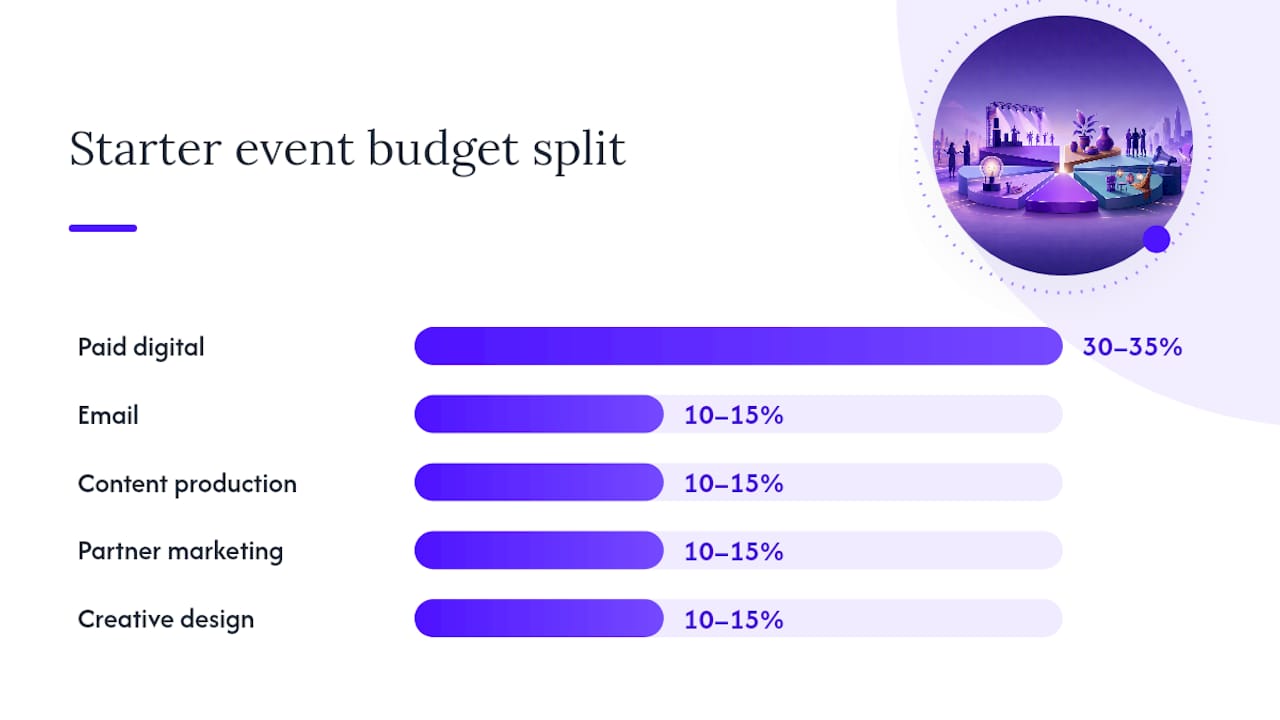
Budget allocation questions almost always arrive as “how much should we spend on ads?” The better question is “how should spend map to what each channel is actually good at?” Paid media buys attention, email converts people who already trust you, and advocacy converts people who trust their friends more than they trust either.
A workable starting split for a mid-market event looks like this, drawn from common benchmark ranges:
Paid digital (Meta, Google, YouTube, Spotify, streaming TV): 30 to 35%
Email marketing: 10 to 15%
Content production (creative assets, video, copy): 10 to 15%
Partner and sponsor co-marketing: 10 to 15%
Creative development and design: 10 to 15%
Event listings and directories receive a smaller portion of the budget
Advocacy and referral incentives receive a smaller portion of the budget
A contingency reserve receives a smaller portion of the budget
Reweight this based on what you’re actually promoting. A season subscription renewal campaign should push email and advocacy weighting up and paid discovery weighting down, since you’re talking to people who already know you. A single debut concert with no existing list needs the opposite: heavier paid digital to build cold awareness fast, since there’s no warm audience to lean on yet.
Channel performance varies enough that blending is nearly always the right call:
Email converts warm lists at 15 to 25%, making it the highest-converting owned channel available to almost any organization with an existing list.
Attendee advocacy, peer sharing and referral links, converts at a share-to-registration ratio near 32%, which is why sponsor and attendee share kits deserve real production time, not an afterthought.
Meta and Google paid campaigns drive reach and new-audience discovery but carry higher cost-per-registration than owned channels, especially in cold-audience targeting.
LinkedIn works well for B2B-adjacent events, industry conferences, professional showcases, but underperforms for consumer-facing concerts and general-admission shows.
Partner co-marketing extends reach into audiences you don’t own, often at a lower blended cost than pure paid acquisition.
Event listing sites are low-cost, low-effort discovery channels worth including but rarely worth over-investing in.
SMS, used sparingly, earns its place in the final 48 hours as a high-open-rate urgency channel tied directly to the ticketing page, not as a general-purpose broadcast tool.
The share-to-registration statistic is worth sitting with. Attendee advocacy converting at roughly 32%, versus far lower rates typical of cold paid channels, means the cheapest lever in your entire plan might be asking happy past attendees to share the event with three friends, not raising your ad budget by another 20%.
What Assets Do You Need to Produce, and When?
Production bottlenecks kill more campaigns than bad strategy does. A plan that says “run paid ads starting T-8” is useless if the landing page isn’t built, the creative isn’t approved, and the email sequence exists only as a bullet point on someone’s to-do list.
Landing page checklist, this needs to be locked before Foundation phase ends:
Clear headline that repeats your one-line elevator pitch above the fold.
A single primary CTA (register, buy tickets) repeated at least twice on the page.
Tracking pixels installed and verified firing correctly (Meta pixel, Google tag, any CRM-linked event pixel).
Mobile load speed under 3 seconds, since a meaningful share of paid traffic will arrive on a phone.
Social proof: past attendance numbers, press mentions, or a short quote if you have one.
Email sequence outline, five touches minimum across the T-minus calendar:
Announcement email (Foundation/Awareness transition): introduces the event and the pitch.
Value-add email (Momentum): shares a preview, artist interview, or behind-the-scenes detail.
Social proof email (Momentum): past attendee quotes, sold-out history, press coverage.
Urgency email (T-2): last chance framing, tied to a registration deadline.
Day-of reminder (T-0): logistics, parking, timing, and a final CTA.
Social calendar and sponsor share kits. Build a lightweight content calendar covering Awareness through Urgency, mixing announcement posts, countdown graphics, and short video teasers. Package a sponsor share kit early, ready-made graphics, suggested captions, and your tracking link, so partners can post the moment you ask instead of waiting on your design team.
On-site capture plan. Assign someone to shoot short video and photo content during the event itself. This isn’t just for memory-keeping; it becomes next quarter’s social proof and the raw material for your post-event recap email.

Pro Tip: Build your sponsor share kit at the same time as your own launch assets, not after. Partners who get materials two weeks late post two weeks late, and that gap usually lands right when you needed the extra reach most.
Which KPIs Actually Belong on Your Dashboard?
A dashboard with 20 metrics gets checked once and ignored. A dashboard with 6 to 8 metrics gets checked weekly, because it’s fast enough to actually act on. Here’s what earns a permanent spot.
Registrations vs. goal: your primary pacing signal, tracked against the T-minus benchmarks above.
Attendance rate: registered vs. actually showed up, which reveals whether your Urgency-phase messaging is working or just generating soft interest.
Cost per registration: blended and by channel, so you can see which channels are earning their budget share.
Landing page conversion rate: visits to registrations, which flags creative or page problems before you waste more ad spend driving traffic to a leaky page.
Share-to-registration ratio: how much of your volume comes from advocacy, a strong signal for where to shift budget.
Pipeline or revenue created: for events tied to sponsorship or membership goals, not just ticket count.
ICP attendance rate: what percentage of actual attendees match your priority segments, since raw headcount can hide a mismatch between who showed up and who you needed to show up.
KPI | Healthy benchmark | Action if below range |
Registrations vs. goal (T-7) | 20–30% of total | Increase paid spend or push email cadence |
Registrations vs. goal (T-4) | 60–75% of total | Activate SMS and urgency messaging early |
Email conversion (warm list) | 15–25% | Revisit subject lines and send timing |
Share-to-registration ratio | High relative to paid | Shift budget from paid toward advocacy incentives |
Reallocation rules should be written down before the campaign starts, not decided in a panic at T-3. If paid channels are underperforming while your advocacy ratio is strong, shift dollars there first, since it’s typically your lowest-cost, highest-trust conversion path.
Instrumentation makes all of this possible. Standardize UTM parameters across every link so channel attribution is clean, confirm event pixels are firing before any paid spend goes live, sync registration and attendance data into your CRM, and run a short weekly pacing report comparing actuals against your T-minus benchmarks. Feeding check-in and engagement data into your CRM is what turns a one-time event into retargeting audiences and future pipeline, not just a nice night.
Copy-Pasteable Templates You Can Fill In Today
Theory doesn’t fill seats. Working documents do. Here’s the skeleton for the three artifacts every plan needs.
1. One-page event marketing plan should include these fields, filled in before you write a single ad:
Primary SMART goal and leading/quality metrics.
Named audience segments and 2 to 4 ICPs.
One-line elevator pitch.
Channel mix with budget percentage per channel.
Owner assigned to each channel and each major task.
Dashboard KPIs and benchmark targets.
2. T-minus schedule template built as a week-by-week table from T-12 through T+4, with three columns: deliverable, phase, and owner. Populate each week with concrete outputs, “landing page live,” “email #2 sent,” “sponsor kit distributed”, rather than vague phase labels.
3. Owner checklist with a status column (Not Started, In Progress, Done, Blocked) reviewed daily during Momentum and Urgency phases, and weekly during Foundation and Awareness. Daily check-ins matter most in the two weeks closest to the event, when small delays compound fast.
For teams promoting single-show concerts or smaller live music events, a compressed planning structure built for release-day promotion adapts well, since the same one-page logic applies whether you’re launching an album or a single performance.
How Opti Arts Turns This Plan Into Paid Media Results
A typical case follows a repeatable arc: a mid-size performing arts venue faces soft ticket sales for an upcoming season, builds a plan around a single primary goal (a defined attendance lift), segments its audience into subscribers, lapsed attendees, and new prospects, then runs a channel mix across Meta, Google, and Spotify weighted toward the segments most likely to convert. Measurement ties every dollar back to actual ticket sales, not just clicks.
What separates this from a generic paid media buy is the data layer underneath it. Opti Arts integrates ticketing data directly into paid campaigns and its Breakeven dashboard, so reallocation decisions during Momentum and Urgency phases happen against real sales data instead of a delayed export from a third-party ticketing system.
When a paid channel’s cost-per-registration and your actual box office numbers live in the same dashboard, you stop guessing which campaign is working and start reallocating budget the same week, not the month after the show closed.
That speed, from data point to budget decision, is the difference between a plan that adjusts mid-campaign and one that only gets evaluated in a post-mortem.
The Planning Mistakes I See on Repeat
Almost every broken event marketing plan I’ve reviewed shares the same three flaws. Someone starts with tactics (“let’s run some ads”) instead of a goal, so nobody can say whether the campaign worked. Tasks get assigned to “the team” instead of a name, so accountability evaporates the moment things get busy. And tracking gets set up in the final week, after paid spend has already started, which means the first stretch of the budget generates data nobody can actually use.
Small teams and cultural organizations feel these mistakes hardest, because there’s no redundancy to absorb a dropped task. The fix isn’t more staff. It’s discipline: one goal, named owners, tracking live before spend starts. That’s the whole difference between a plan and a wish list.
— Trevor
Get Hands-On Help Building and Running Your Plan
Building the plan is half the work. Running it across six paid channels while watching a dashboard daily is the other half, and it’s where most in-house teams run out of bandwidth. Optiarts gives cultural organizations a shortcut past the trial-and-error phase: instead of spending a season learning which channel mix actually converts for museum and theater audiences, you get campaigns built by a team that already knows the benchmarks for this category specifically.
Optiarts runs data-driven paid campaigns across Meta, Google, YouTube, Spotify, and streaming TV, tailored to the audience segments and goals you define in your own plan. The Breakeven dashboard ties ticketing data directly into campaign performance, so reallocation decisions happen in days, not at the end of a reporting cycle. Bespoke campaign strategy means your budget split reflects your actual event type, not a generic template. Marketing teams at theaters, museums, and concert venues who want a managed alternative to building this in-house can review Opti Arts’s services and request a walkthrough of how the plan above translates into a live campaign for their next event.
Sources
Recommended