

Ticket First Exhibition Marketing Plan for Museums: 4–8 Week Prelaunch

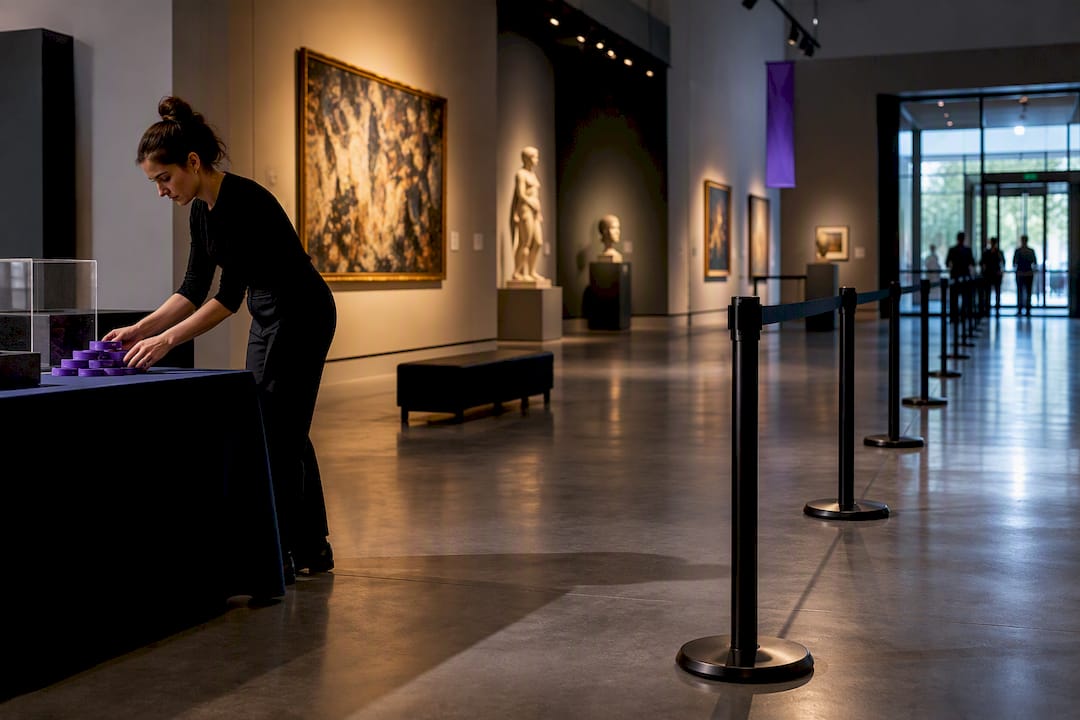
An effective exhibition marketing plan ties one clear attendance or revenue KPI to a targeted promotional mix and a phased timeline. Set that KPI first. Everything else, from audience segmentation to media buys, exists to move that single number, so your first action is picking the metric and the primary audience segment that will get you there.
TL;DR:
Campaigns should prioritize audience segments with existing trust, like members, families during peak times, affinity groups, and local schools, to maximize ROI.
The promotional mix must be tailored to the funnel stage, with TV and YouTube for awareness, social and audio for consideration, and search plus retargeting for conversion.
Balanced budget allocation involves heavy investment in paid channels during launch and sustained, low-cost engagement through email, memberships, and community activations.
Accurate tracking requires UTM tags, ticket source data, and blended attribution to properly measure ticket conversions, revenue, and return on ad spend.
Contingency plans, creative deadlines, and phased campaign structure help mitigate risks like delays, underperformance, capacity issues, and external disruptions.
Table of Contents
What Is an Exhibition Marketing Plan?
An exhibition marketing plan is the working document that connects your show’s opening date to a revenue or attendance target through specific audiences, channels, and a measurement system. Think of it as the score everyone in the building plays from, curators, front-of-house, digital, and development alike. Sector research from the Smithsonian’s Office of Policy and Analysis found that the strongest plans answer six questions before a single ad gets bought: what does success look like, who is the market, does the show fit the institution’s brand, what promotional mix will reach that market, what is the total budget, and what visitor services need to scale alongside attendance.
The framework below breaks into six working parts, and you can build most of it in an afternoon if you already know your show’s story.
1. Objectives and targets. Set the primary KPI (paid attendance, ticket revenue, or member conversions) and a secondary KPI (average dwell time, repeat-visit rate). Give both a number and a date.
2. Audiences and messages. Rank your segments by likely conversion, not by size. A tight message for a 5,000-person affinity group often outperforms a vague one aimed at 500,000 locals.
3. Promotional mix. Assign each channel a funnel role, awareness, consideration, or conversion, so no two channels are duplicating the same job.
4. Budget and timeline. Split spending across pre-launch, opening, and sustain phases rather than dumping it all in week one.
5. Measurement. Decide your reporting cadence before launch, not after the first invoice arrives.
Practical templates from Te Papa’s marketing planning guide follow the same skeleton: objectives, target markets, promotional mix, budget, and measures, matched directly to the activities you plan to run. That alignment, activity to target, is where most plans quietly fall apart.
Your checklist for this stage:
Confirm the KPI and the number attached to it
Name your top two audience segments
Draft one core message per segment
Set a total budget and rough phase split
Choose your reporting rhythm (weekly during launch, monthly during sustain)
Which Audiences Should You Target First?
Not every segment deserves equal budget. Locals with existing membership ties tend to convert fastest because they already trust the institution and need only a nudge, a preview night, a discount window, a friend’s recommendation. Families cluster around school breaks and weekends, so their conversion window is narrow but predictable. Affinity groups, art societies, alumni networks, professional guilds tied to your subject matter, often deliver outsized ROI because their interest is pre-qualified; you’re not creating demand, you’re routing it. Schools require longer lead times and group-sales infrastructure, but they anchor weekday attendance when general admission runs soft. Tourists convert well near landmarks and during peak travel months, though they’re harder to retarget once they’ve left town.
Estimating segment size starts with what you already have: email list size, membership rolls, past exhibition attendance by zip code, and school-visit history. Audience segmentation research recommends layering behavioral data (past visits, email opens) over demographic data, since behavior predicts conversion far better than age or income alone.
Match messages to motivation:
Urgency: “Final six weeks” performs better than an open-ended run date.
Exclusives: member previews and after-hours access reward loyalty and create social proof.
Educational hooks: curator-led framing works especially well with school and affinity audiences.
How Should You Structure Your Promotional Mix?
Your channel mix should mirror the funnel, not scatter budget evenly across everything available. Connected TV and YouTube build the top-of-funnel awareness that gives a show cultural weight before ticket links even matter. Social platforms and digital audio (Spotify, podcast networks) carry consideration, the phase where a viewer decides whether this exhibition fits their weekend. Search and retargeting close the loop, catching people who already showed intent but haven’t bought yet.
Owned channels matter more than most marketing teams give them credit for. Email lists and membership programs convert at a fraction of the cost of paid media, and member perks, early access, guest passes, exclusive tours, do double duty: they reward loyalty and generate the kind of word-of-mouth that paid ads can’t buy.
Physical activations are the most underused lever in exhibition marketing. A pop-up booth at a street festival, a branded banner at a farmers market, a tie-in booth at a food and wine event, these seed the digital retargeting pool that closes sales later. Case analysis from the American Alliance of Museums found integrated physical-to-digital campaigns, where a bold on-site presence sparks curiosity and digital retargeting captures it, consistently outperform channels run in isolation.
Practical mix checklist:
CTV and YouTube for reach and cultural framing
Meta and audio for consideration and creative storytelling
Search and retargeting for conversion
Email and membership perks for retention and referral
Pop-ups and community tie-ins to build addressable audiences
Pro Tip: Film every pop-up interaction on your phone. Thirty seconds of a real visitor reacting to your exhibit outperforms most studio-shot ad creative, and it costs nothing to produce.
How Long Should Your Exhibition Campaign Run?
Break your calendar into three phases, each with its own job to do.
Pre-launch (4 to 8 weeks out): Build awareness with CTV, YouTube, and earned press. Objective: seed recognition before tickets go on sale.
Opening (launch week through the first month): Shift budget toward search and retargeting, where intent is highest and conversion is cheapest. Objective: capture the initial demand spike.
Sustain (the remaining run): Scale back paid spend and lean on email, membership perks, and off-peak promotions to keep the long tail moving. Objective: protect capacity utilization once the initial wave passes.
Sector research from the Smithsonian confirms paid promotion reliably lifts attendance, but the return depends on matching frequency and placement to the show’s actual drawing power, not just spending more.
To fill weekday gaps, borrow tactics that work elsewhere: discounted weekday windows and member-only off-peak perks. TicketSpice’s research on attendance patterns found these behavior-change tactics move visitors into slower periods more reliably than awareness advertising alone.
What KPIs Actually Prove the Campaign Worked?
Four numbers matter more than the rest: ticket conversions by channel, incremental attendance versus your pre-campaign baseline, revenue per visit, and return on ad spend (ROAS). Everything else, impressions, reach, engagement rate, is a leading indicator at best.
Attribution gets messy fast in exhibition marketing, because a visitor might see a CTV spot, click a retargeting ad three days later, and buy through a member email. Last-click attribution undercounts your awareness channels; view-through attribution overcounts them. The pragmatic answer most cultural marketers land on is a blended model: use last-click for search and retargeting, view-through for CTV and audio, and treat email conversions as assisted rather than sole credit.
None of this works without clean data collection from day one:
UTM tags on every link, every channel, every creative variant
Ticket-source tagging inside your ticketing platform
Time-of-day and day-of-week purchase patterns
Attendee type (member, general, group, school)
Report weekly during launch and opening, then shift to a single post-campaign report once you’re in sustain mode. A KPI dashboard built around source-tagged conversions, cost per ticket by channel, and revenue per visit turns this from a spreadsheet chore into a live decision-making tool, one you can actually check on a Tuesday morning rather than reconstruct after the fact.
Four Campaign Recipes You Can Copy This Quarter
Influencer-led paid social. Hand your creative budget to a local influencer instead of a production house. A case study involving The George Eastman Museum found influencer-sourced creative lowered production costs while increasing click-through rates, largely because it reads as a recommendation rather than an ad.
Pop-up to retargeting pipeline. Run a branded booth at a community festival, collect emails or track engagement through a QR code, then retarget that list across Meta and search for the next six weeks. MuseumNext’s guidance on community engagement treats outside events as partners worth activating, not competitors for attention.
Weekday member incentive. Offer a Tuesday-Thursday discount exclusively to members. This shifts demand into your slowest days without discounting your weekend peak.
CTV plus audio awareness burst. Pair a two-week CTV flight with Spotify placements timed to the same creative theme, then measure the lift in branded search volume that follows.
Match each recipe to a KPI before you launch it:
Influencer-led social → cost per click and ticket conversions
Pop-up pipeline → retargeting list size and assisted conversions
Weekday incentive → weekday attendance versus baseline
CTV/audio burst → branded search lift and view-through conversions
How Opti Arts Approaches Exhibition Campaigns
Opti Arts builds its practice specifically around cultural organizations, museums, theaters, and galleries facing the exact channel-fragmentation problem this article walks through. Rather than treating a museum client like a generic small business, the agency’s campaign work runs data-driven media across Meta, Streaming TV, Spotify, Google, YouTube, and social, the same channel set the funnel above depends on.
What sets the solutions apart is the pairing of bespoke creative strategy with a performance dashboard built for this sector specifically, so a marketing director isn’t stitching together five separate ad-platform reports to answer one question: did this exhibition make its number?
A few things worth knowing about how the approach fits into a plan like the one above:
Campaigns are built around a client’s specific budget and goals rather than a fixed package
Media buying spans the full awareness-to-conversion funnel described in the promotional mix section
Performance tracking runs through a dashboard designed to sit alongside your existing ticketing setup
and would round this section out with concrete before-and-after figures once available.
How Do You Position an Exhibition Against Competing Options?
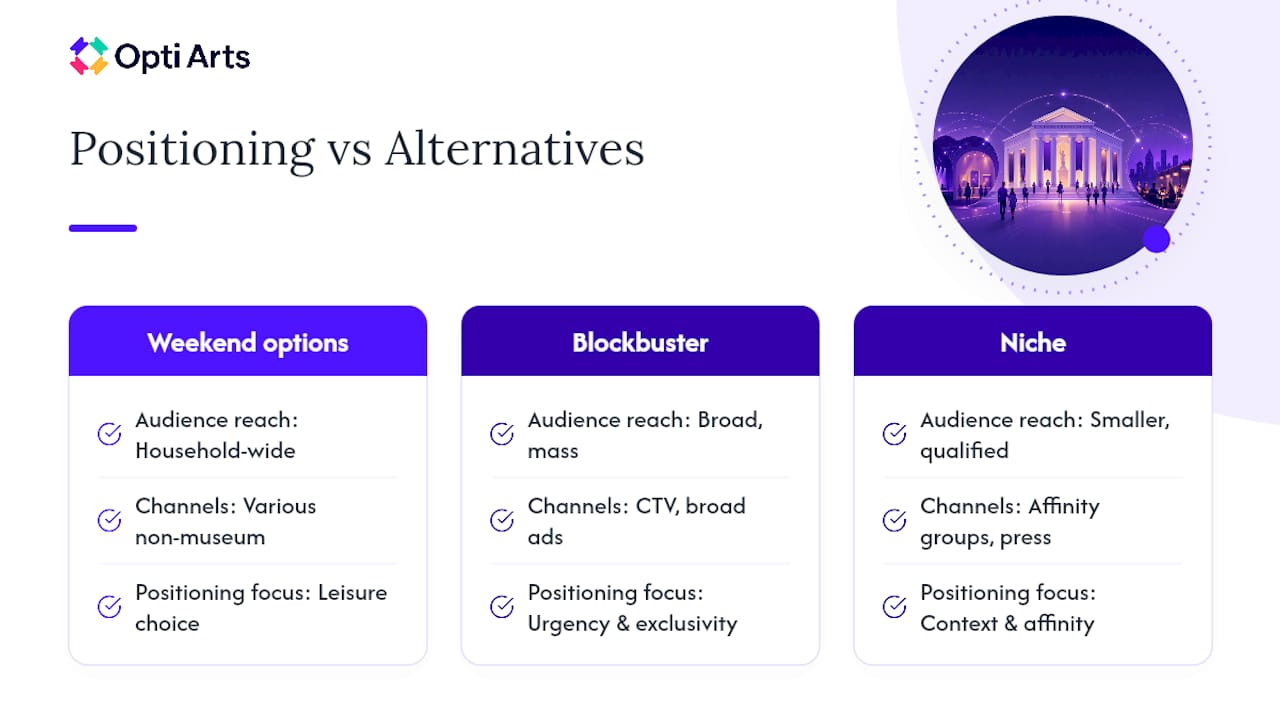
Your real competition isn’t the museum across town, it’s every other way a household could spend a Saturday. Framing your show only against other institutions’ calendars misses the actual decision your audience is making: exhibition versus streaming a movie, versus a weekend trip, versus doing nothing at all.
That reframe changes your positioning work. Instead of asking “how do we beat the gallery down the street,” ask “why does this exhibition deserve three hours of someone’s weekend more than the alternatives competing for that same block of time.” Urgency (limited run dates), exclusivity (content unavailable anywhere else), and social currency (something worth posting about) answer that question better than institutional comparisons ever will.
Positioning also means being honest about where your show sits on the spectrum between blockbuster and niche. A blockbuster-scale exhibition can lean on broad awareness channels like CTV because the audience is wide. A niche or scholarly show performs better leaning into affinity groups and earned press, where a smaller, more qualified audience already has context for why the subject matters.
Look sideways at adjacent institutions too, not to copy them, but to spot gaps. If every gallery in your market is running family-day promotions, a weekday professional-audience angle might be wide open. If competitors are all chasing tourists, your local member base becomes the less contested, cheaper-to-reach opportunity.
The plan’s promotional mix section should reflect this positioning decision directly. Don’t build the same channel spread for a blockbuster retrospective and a quiet, focused photography show. They’re competing for different slices of someone’s free time, and the mix should say so.
How Do You Capture and Nurture Leads Beyond the Ticket Sale?
A ticket purchase is a data point, not the finish line. The email captured at checkout, the phone number from a pop-up booth, the social follower gained during a festival tie-in, each represents a lead worth nurturing toward membership, repeat visits, or donor conversion.
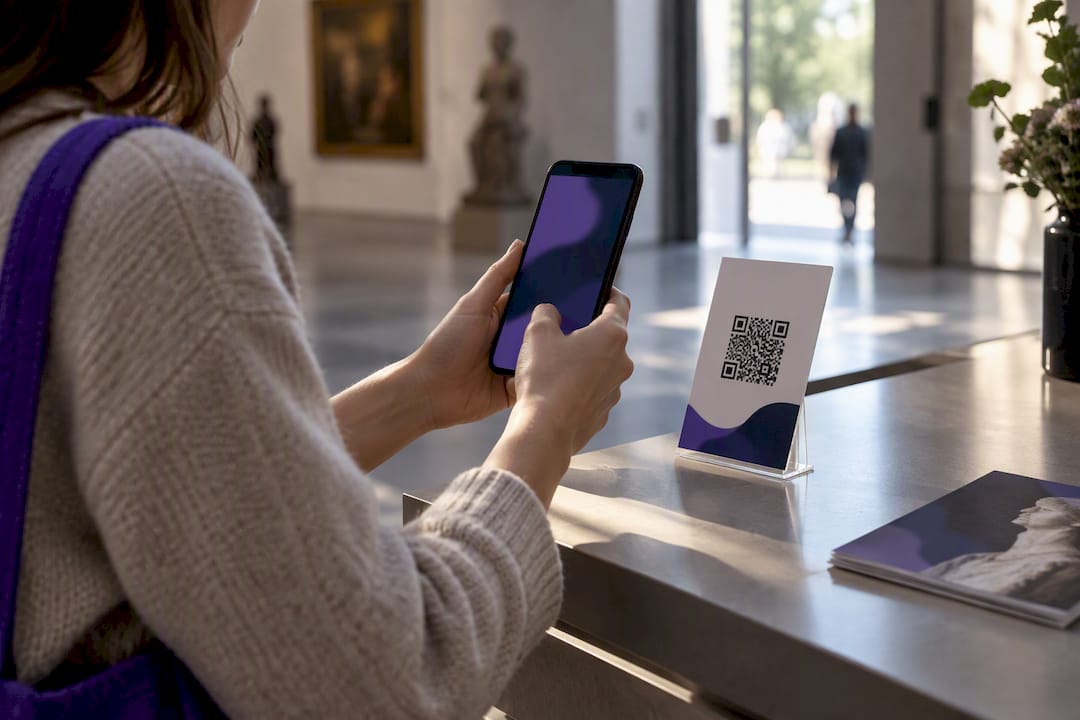
Capture starts before the exhibition opens. Waitlist signups for preview nights, RSVP forms for member events, and QR codes at community activations all build a list before a single ticket sells. During the run, in-gallery prompts, a tablet at the exit asking for an email in exchange for a discount code toward the next show, keep the pipeline growing.
Nurturing this list separates one-time visitors from long-term supporters. A simple three-touch sequence works well: a thank-you email within 48 hours, a related-content email two weeks later (an artist interview, a curator’s note), and a membership or next-exhibition offer at the six-week mark. Segment by behavior, not just by purchase, someone who bought a family pack gets different messaging than someone who came alone to a members’ preview.
Group sales and school bookings deserve their own nurture track entirely, since the sales cycle runs longer and the decision-maker is rarely the eventual attendee. A dedicated group-sales contact point, response within 24 hours, matters more here than any automated sequence.
The institutions that grow membership fastest treat every exhibition as a lead-generation event first and a ticket-revenue event second. The ticket pays today’s bills; the list pays for the next five exhibitions.
What Could Go Wrong, and How Do You Plan Around It?
Every exhibition campaign carries the same handful of risks, and most of them are predictable enough to plan around in advance rather than react to under pressure.
Creative delays. Approval chains involving curators, legal, and leadership can stall a launch by weeks. Build a hard creative deadline at least ten days before your pre-launch phase begins, with a fallback asset ready if final approval slips.
Underperforming channels. Not every platform will hit projections. Set a two-week checkpoint after launch to review cost-per-ticket by channel and reallocate budget away from underperformers rather than waiting for a post-mortem.
Capacity mismatches. A campaign that works too well can oversell timed-entry slots or overwhelm staffing on peak days. Coordinate your marketing calendar with operations before launch, not after ticket sales spike unexpectedly.
External disruption. Weather cancels a planned pop-up. A regional news story shifts media attention. Build a contingency line into your budget, roughly 10% held in reserve, that can shift toward digital channels if a physical activation falls through.
Message fatigue. Running the same creative for twelve weeks straight burns out your retargeting audience. Rotate creative variants at least every three to four weeks during longer runs.
The common thread across all of these: contingency planning works best when it’s a checklist reviewed before launch, not a scramble improvised mid-campaign. A short pre-flight review, creative locked, staffing confirmed, budget reserve set, channel fallbacks identified, catches most of these risks before they cost you attendance.
How Do You Measure ROI After the Exhibition Closes?
The work isn’t finished when the show comes down. Post-event evaluation is where you turn one campaign into a repeatable playbook for the next one.
Start with a final attribution pass within two weeks of closing. Reconcile every ticket sold against its source channel, compare final attendance against your original baseline projection, and calculate actual ROAS against the number you set in the objectives stage. This is also when blended attribution matters most, a visitor’s full path (CTV exposure, retargeting click, email nudge) tells you more than any single last-click number.
Compare performance against your phase-based projections specifically. That gap tells you where to shift budget on the next campaign.
Survey a sample of attendees, in person or via a post-visit email, about how they heard about the show. Self-reported discovery data won’t replace UTM tracking, but it often surfaces influence you can’t attribute digitally, a friend’s recommendation, a local news mention, word of mouth from a member.
Document what worked and what didn’t while the details are still fresh: which creative variant performed best, which audience segment converted at the lowest cost, which phase overspent or underspent. This becomes the opening chapter of your next exhibition’s plan, so you’re not rebuilding your framework from scratch every single time.
Where Marketing Leaders Get the Trade-Offs Wrong
The biggest mistake I see is treating awareness and conversion budgets as interchangeable when they’re not. Awareness spend earns its keep months before a ticket sells; conversion spend earns its keep in the final two weeks. Front-load the wrong one and you’ll either burn budget on reach nobody converts or chase conversions with no pool of aware buyers to draw from.
The real pitfalls are organizational, not tactical: departments running campaigns in silos with no shared KPI, vague success metrics nobody agreed on before launch, and creative approvals that slip until there’s no runway left to test variants. Before any campaign goes live, run a short governance check: is the KPI signed off by leadership, is creative locked with time to spare, and does everyone touching the campaign know which number they’re accountable for?
— Trevor
Let Opti Arts Run the Media While You Run the Museum
Opti Arts exists specifically for the gap this article keeps circling back to: cultural institutions need media strategy built for their audiences, not a generic small-business playbook stretched to fit. The agency’s service lineup, spanning Meta, Google, YouTube, Streaming TV, digital audio, and display, covers the full funnel from awareness through conversion described above, and the campaigns are built around your institution’s specific goals and budget rather than a fixed package.
Where this becomes genuinely useful for a marketing director juggling multiple channels is the reporting side. The Breakeven dashboard ties campaign performance directly to ticket sales, so you’re checking one screen for cost-per-ticket by channel instead of reconciling five separate ad platform reports at the end of each week. If your next exhibition needs a media plan and a way to prove it worked, request a walkthrough of the solutions and see how the dashboard maps to your existing ticketing setup.
Sources
FAQ
What Is the First Step in Building an Exhibition Marketing Plan?
Set your primary KPI, whether that’s paid attendance, ticket revenue, or member conversions, before choosing any channel or creative direction. Every budget and timeline decision that follows should trace back to that single number.
How Much Budget Should Go to Paid Media vs. Owned Channels?
There’s no universal ratio, but a common structure puts the majority of new spend into paid awareness and conversion channels during launch, while leaning on email and membership perks, which cost far less per conversion, to sustain the long tail. Paid promotion research confirms paid spend reliably lifts attendance when matched to the show’s actual drawing power.
How Do You Track Whether a Campaign Actually Drove Ticket Sales?
Tag every link with UTM parameters, capture ticket source inside your ticketing platform, and use a blended attribution model that credits search and retargeting on last click while giving CTV and audio credit through view-through data. A dashboard like Opti Arts’s Breakeven is built to surface these numbers by channel automatically.
Can Physical Activations Like Pop-Ups Really Improve Digital Results?
Yes. Physical activations at community events or festivals build addressable audiences that digital retargeting can then convert, an approach documented by the American Alliance of Museums as consistently outperforming purely digital or purely physical campaigns run in isolation.
What Does Opti Arts Charge for Exhibition Marketing Services?
Opti Arts builds campaigns around each institution’s specific goals and budget rather than publishing a fixed rate card. Current pricing details and service scope are available directly through the Opti Arts solutions page.
Recommended